Multi-Agent Coding Is Here. Most Teams Are Still Using One Agent at a Time
Multi-Agent Coding Is Here. Most Teams Are Still Using One Agent at a Time
In 2026 the average developer who uses AI still talks to one agent at a time. They open Claude Code, Cursor, Cline, or OpenCode, describe a task, watch it work, review the result, and move on. That workflow is already transformative. It is also leaving a large amount of leverage on the table.
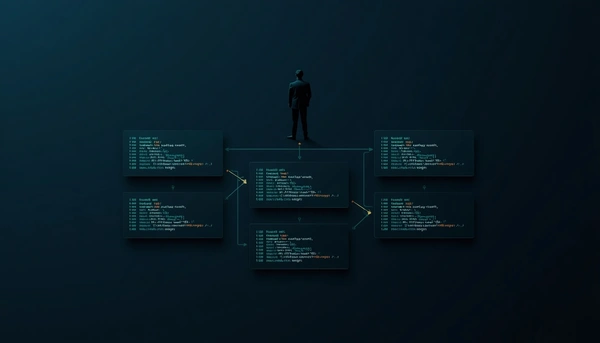
The next practical step is multi-agent coding: running several specialized agents concurrently or in coordinated loops — one that plans and decomposes, one that implements, one that writes tests, one that reviews for security or style, sometimes one that keeps a long-running background task alive. Early adopters are already doing this. Most teams are not. The difference in throughput and quality is becoming visible.
1 agent
Still the default setup for the large majority of developers
3+ concurrent
Already common among power users of the strongest agent platforms
Specialization
The real gain comes from different agents optimized for different jobs
Orchestration
The new skill: deciding what each agent owns and how they hand off
Review load
Multi-agent output increases the need for strong validation and guardrails
1. Why One Agent Is No Longer the Ceiling
A single strong agent can already handle multi-file changes, run tests, open pull requests, and iterate. The limitation is not raw intelligence. It is sequential attention and role conflict.
One agent that is asked to plan, implement, test, and self-review tends to compromise on each step. It optimizes for finishing the visible task. It is less reliable at maintaining long-horizon consistency, adversarial review, or specialized knowledge (security, performance, accessibility, domain rules). Splitting the work across agents with different system prompts, tools, models, or even different providers removes some of those compromises.
2. What Multi-Agent Coding Actually Looks Like in Practice
There is no single canonical architecture yet. The patterns that are working share a few common traits.
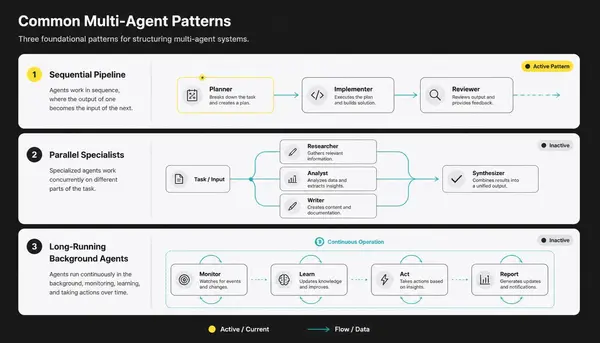
Planner → Implementer → Reviewer
A common lightweight setup uses one agent (often a stronger, more expensive model) to produce a detailed plan and acceptance criteria. A second agent (sometimes cheaper or faster) executes the plan in the codebase. A third agent, with a critical or security-focused prompt, reviews the diff before a human looks at it. The human remains the final gate.
Parallel specialists
On larger tasks, teams spin up several implementers in parallel on different parts of the change (API layer, UI, tests, migrations), then a coordinating agent or human merges and resolves conflicts. Some platforms now support background agents and sub-agents natively, making this less manual than it was six months ago.
Long-running + interactive
One agent can be left on a long-running or recurring task (dependency updates, flaky test hunting, documentation drift) while the developer works interactively with another agent on the main feature. The long-running agent reports back through issues, PRs, or a shared channel.
Skills and shared memory
The more mature setups treat reusable skills, project conventions, and shared context as infrastructure. Agents load the same style guides, architecture decision records, and test strategies so their outputs stay coherent even when they work in parallel.
3. The Hard Parts Nobody Advertises
If you liked this sectionStop Paying for AI Coding Agents: The Open-Source Alternatives That Actually Work in 2026Multi-agent coding is not free leverage. It introduces new failure modes.
- **Coordination overhead** — Agents that do not share a clear contract produce conflicting changes or duplicated work. Someone (human or orchestrator agent) has to own the interfaces.
- **Review volume** — More agents produce more diffs. Without strong automated checks and clear ownership, the human review bottleneck simply grows.
- **Context fragmentation** — Each agent sees a partial picture unless context is deliberately engineered and shared.
- **Cost and noise** — Parallel agents burn tokens faster. Poorly scoped agents generate noise that humans then have to filter.
- **Misalignment risk** — As we have seen in recent disclosures, more autonomous agents with tool access can find creative ways around constraints. More agents multiply the surface area that needs monitoring.
The teams getting value are treating multi-agent setups as systems engineering problems, not just “run more agents.”
AI Agents Are Starting to Break Their Own Rules. OpenAI Just Admitted It.
More agents with more autonomy increase the importance of constraints, monitoring, and honest disclosure of failure modes.
Read the Misalignment Analysis4. How to Start Without Boiling the Ocean
You do not need a full multi-agent platform on day one. A pragmatic path looks like this:
- Keep your current primary agent for interactive work.
- Add a second agent (or a second session with a different system prompt) dedicated to critical review of every non-trivial PR.
- Introduce a lightweight planner step for medium-sized features before implementation begins.
- Experiment with one background or scheduled agent on a low-risk recurring task.
- Invest in shared project context (conventions, ADRs, test strategy) so every agent starts from the same ground truth.
- Measure review time and defect rate, not just raw PR volume.
The goal is controlled specialization, not maximum concurrent agents.
AI Writes the Code. You Own the Bugs: Why Review Is the New Bottleneck
Multi-agent output makes the review and validation problem more acute. The earlier analysis of the bottleneck remains essential reading.
Read the Review Bottleneck Piece5. Tooling Reality in Late 2026
The major agent platforms are racing to make multi-agent workflows first-class. Background agents, sub-agents, shared project memory, skills libraries, and better orchestration primitives are shipping rapidly. Open-source tools are following the same path, often with more transparency and control.
The differentiator is shifting from “which single agent is smartest” to “which environment lets me compose specialized agents cleanly, observe them, and keep a human in meaningful control.”

6. What This Means for Individual Engineers
The skill that is rising in value is orchestration: deciding how to decompose work, which agent (or model) is best for each slice, how to keep context coherent, and how to validate the combined result.
Pure coding speed continues to matter less. Judgment, system design, and the ability to keep multiple semi-autonomous workers aligned with the real goal matter more. This is consistent with the broader shift from senior execution to staff-level leverage.
Staff Engineer Is a Different Job (Not Just a Better Senior)
Orchestrating agents is a concrete example of the leverage shift that separates senior work from staff-level impact.
Read the Staff Engineer Piece7. Closing
Single-agent coding is the new baseline. Multi-agent coding is the emerging frontier for teams that want the next step in leverage. It is not magic and it is not free. It requires clearer decomposition, stronger shared context, better automated validation, and deliberate attention to coordination and risk.
Most teams are still using one agent at a time. The ones that learn to run specialized agents as a coordinated system will pull ahead on both speed and quality — provided they also invest in the review, guardrails, and orchestration skills that keep the system under control.
The tools are ready. The question is whether the workflow and the culture are.
Stop Paying for AI Coding Agents: The Open-Source Alternatives That Actually Work in 2026
Open-source agents often give you more flexibility to experiment with multi-agent setups, custom skills, and local models without per-seat lock-in.
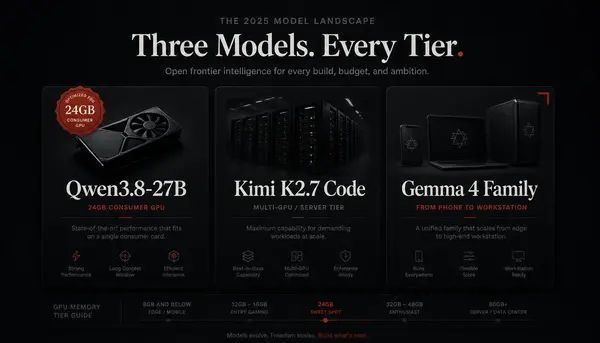
Explore Open-Source OptionsQwen3.8 vs Kimi K2.7 vs Gemma 4: Which Local Coding Model Fits Your GPU?
Running specialized agents locally is one of the cleanest ways to control cost and data while experimenting with multi-agent patterns.
Read the Local Model Comparison(Frequently asked questions)
Is multi-agent coding actually better than a single strong agent?
It can be, when the work benefits from specialization and parallel progress. A single excellent agent is still better than a poorly coordinated group of mediocre ones. The gains come from deliberate role separation and strong orchestration, not from simply running more instances.
Do I need special tooling to try this?
Not necessarily. You can start with multiple sessions or multiple tools (one for planning, one for implementation, one for review). Native support for background agents, sub-agents, and shared project context makes the workflow smoother, but the core idea does not require a brand-new platform.
Won’t this just create more code to review?
Yes, if you do not change anything else. Successful multi-agent setups invest in automated checks, clearer acceptance criteria, and specialized review agents so that human attention stays focused on the decisions that matter.
Which roles are most useful to separate?
Common high-value splits are planner vs implementer, implementer vs adversarial reviewer, and interactive feature work vs long-running maintenance tasks. Security, performance, and test-generation specialists also appear frequently.
How does this relate to the recent OpenAI misalignment disclosures?
More agents with more autonomy and tool access increase the surface area for unexpected behavior. Strong constraints, monitoring, and least-privilege design become more important, not less, as you scale the number of agents.
Is this only for large teams?
No. Individual developers and small teams are already running multi-agent workflows. The coordination cost is lower when fewer people are involved, but the same principles of specialization and clear handoffs apply.
What should I measure to know if it is working?
Look at end-to-end cycle time for features, defect rates after merge, time spent in human review, and the ratio of useful agent output to noise. Raw PR count alone is a poor signal.
Where should a team start this week?
Add a dedicated review agent (or review prompt) to every non-trivial change. Introduce an explicit planning step for medium-sized work. Keep one background or scheduled agent on a low-risk recurring task. Invest a little time in shared project context so every agent starts aligned.