SEO vs GEO: What's the Difference?
— به انگلیسی منتشر شده
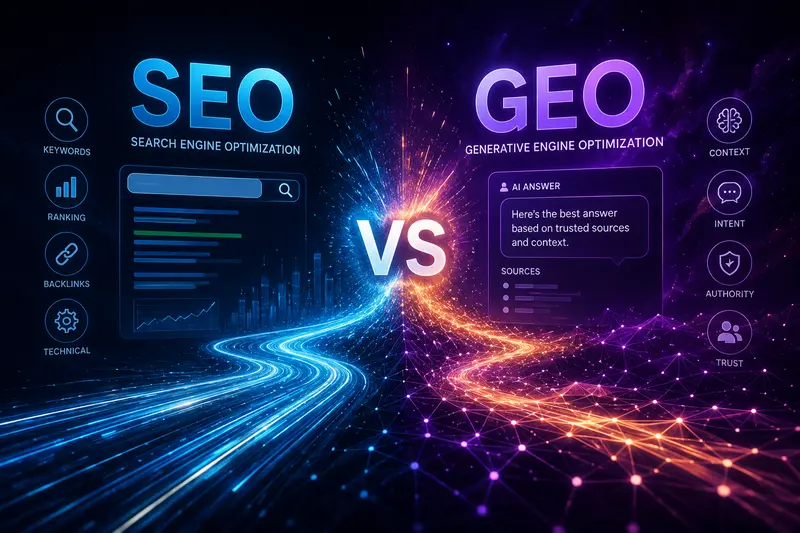
Search engine optimization (SEO) and generative engine optimization (GEO) are often confused — but they serve fundamentally different purposes. SEO helps you rank in traditional search results. GEO helps you get cited inside AI-generated answers. This guide breaks down the differences, the overlaps, and why you need both in 2026.
The Two Faces of Modern Search
If you've been in digital marketing for more than a year, you know what SEO is. But GEO? That's newer. And the confusion between the two is growing fast — partly because the acronyms sound similar, partly because the lines between traditional search and AI search are blurring, and partly because a lot of people are selling GEO services without really understanding what they're selling.
Here's the shortest version: SEO (Search Engine Optimization) is about ranking in search engine results pages — getting your link to appear when someone types a query into Google or Bing. GEO (Generative Engine Optimization) is about getting your brand cited inside AI-generated answers — the kind of responses you get from ChatGPT, Perplexity, Google AI Overviews, and Claude.
اگر این بخش را دوست داشتیدZero-Click Search Is Here. Now What?They sound similar. They share some tactics. But the goal, the metric, the audience, and the mechanics are fundamentally different. This article explains exactly how — and why you can't afford to ignore either one in 2026.
What Is SEO? (The One You Already Know)
Search Engine Optimization is the practice of improving a website's visibility in organic search engine results. It's been around since the late 1990s. The core mechanics are well understood: keywords, backlinks, technical health, content relevance, and user experience.
Traditional SEO targets search engines like Google and Bing. It optimizes for ranking signals. The goal is to appear on page one — ideally in the top three positions — so users click through to your website. Success is measured in rankings, organic traffic, click-through rate, and conversions.
اگر این بخش را دوست داشتیدمرگ وبسایتهای سنتی: طراحی برای ایجنتهای هوش مصنوعیThe output of a traditional search is a list of ten blue links. Users scan the results, choose one, and click. That click is the conversion event for SEO. Everything SEO does — from keyword research to link building to technical optimization — is in service of earning that click.
This model worked beautifully for twenty-five years. Then AI arrived.
What Is GEO? (The One You Need to Learn)
Generative Engine Optimization is the practice of structuring content and brand presence so that AI-powered platforms cite, recommend, or mention your brand when users ask questions. The term was first formalized in a 2023 academic paper from researchers at Princeton, Georgia Tech, and the Allen Institute for AI. A 2024 Princeton/KDD study found that applying GEO techniques can lift a source's visibility by up to 40% in generative engine responses.
Unlike SEO, which targets traditional search engines, GEO targets generative AI platforms: ChatGPT, Google AI Overviews, Google Gemini, Perplexity, Claude, and Microsoft Copilot. These platforms don't return a list of links. They synthesize information from multiple sources into a single, conversational answer.
GEO doesn't chase rankings — because there are no rankings in generative search. It chases citations. The goal is to be included in the AI's synthesized response. When ChatGPT answers a question and cites your brand or content, that's a GEO win.
GEO is not a replacement for SEO. It is a complementary discipline that addresses a new reality: a growing share of search traffic never reaches websites at all.
SEO vs GEO: The Core Differences
The differences between SEO and GEO are not subtle. They target different platforms, optimize for different outputs, and measure success in completely different ways. Here's the breakdown.
As Pimberly's 2026 GEO vs SEO analysis frames it: SEO optimizes for discovery, while GEO optimizes for comprehension. Search engines find your page; AI engines extract meaning from it.
The Zero-Click Problem: Why GEO Exists
The single most important reason GEO exists is zero-click search. Users are getting answers directly in the search interface — without ever clicking through to a website. This is not a future trend. This is the current reality of the web.
According to recent data, nearly 60% of Google searches now end without a click to any website. When an AI Overview appears in results, click-through rates drop by nearly 60%. In 2024, U.S. zero-click searches stood at 60.45%. Over the last two years, we've seen 12.5% growth in clickless queries — the fastest acceleration in the last decade, driven by the massive growth of AI Overviews.
The numbers are stark. AI Overviews now appear on more than 20% of all searches. For news queries, zero-click rates rose from 56% to 69% in the year after AI Overviews launched. Gartner predicts that traditional search volume will decline by 25% in 2026 as users shift to conversational AI and direct answer interfaces.
The traffic that SEO built over decades is being absorbed by AI answers. If you're still measuring SEO success primarily by organic clicks, you are measuring a shrinking pool. GEO exists because being cited in the AI answer is now the conversion event.
Zero-click search has fundamentally changed what "visibility" means. A page-one ranking is no longer a guarantee of traffic. If the AI answers the user's question before they see your link, your ranking doesn't matter. The new visibility metric is citation frequency — how often your brand appears inside AI-generated responses.
What SEO and GEO Have in Common
Despite their differences, SEO and GEO share foundational principles. They are not opposing forces. They are two sides of the same coin — and the best strategies integrate both.
First, content quality is non-negotiable for both. Both search algorithms and AI models favor accurate, well-researched, and up-to-date material. Thin, generic content fails in both SEO and GEO.
Second, structure matters. Clear headings, subheadings, and logical flow help search crawlers evaluate relevance while guiding AI engines to extract key facts accurately. Well-organized content is easier for people to scan and for machines to parse.
Third, E-E-A-T signals matter in both. Experience, Expertise, Authoritativeness, and Trustworthiness are now defining factors for AI search results, not just Google ranking signals. As Ragan Communications notes, "While SEO has long rewarded relevance and authority, GEO picks up on those same signals — favoring brands AI considers credible, consistent and well-referenced across the web."
Fourth, topical authority contributes to visibility in both. Publishing clusters of related, high-quality content helps you gain visibility in SERPs and LLMs.
As one SEO veteran put it: "Good SEO is good GEO." If you already produce strong SEO content, you're halfway to GEO.
The Death of Traditional Websites: Designing for AI Agents
Want to understand why traditional web design is breaking down in the age of AI agents? This deep dive covers GEO, llms.txt, structured data, and how to design for both human and machine readers.
How to Optimize for SEO in 2026
SEO isn't dead. It's just no longer sufficient. The fundamentals still work, but they need to be executed at a higher level than ever before.
- Target specific keywords with clear intent — but think beyond single phrases to topic clusters
- Build high-quality backlinks from authoritative, relevant sources
- Ensure technical health: fast load times, mobile responsiveness, HTTPS, clean code
- Create depthful content that genuinely answers user questions
- Optimize for featured snippets — these still capture clicks and visibility
- Monitor rankings and organic traffic, but don't panic when AI Overviews reduce CTR — that's the new normal
How to Optimize for GEO in 2026
GEO requires a different set of tactics. Here's what actually moves the needle on AI citations.
- Lead every section with a direct answer — context follows, it does not precede
- Use clear H1/H2/H3 heading hierarchies with one topic per section
- Write in scannable formats: bullet points, numbered lists, short declarative paragraphs
- Support every claim with specific statistics, dates, and named sources — authoritative markers increase citations
- Implement structured data: FAQPage, Article, Product, and Organization schema
- Ensure all key content is server-side rendered, not JavaScript-dependent
- Verify AI crawlers (GPTBot, ClaudeBot, PerplexityBot) are not blocked in robots.txt
A 2024 Princeton study found that including citations, quotations from relevant sources, and statistics can significantly boost a website's visibility in AI search results. Content that answers specific, natural-language prompts — clearly, concisely, with factual depth — is more likely to be cited.
The llms.txt Debate: Helpful or Hype?
llms.txt is a Markdown file placed at the root of your website that provides AI systems with a structured description of your content. It's been described as "robots.txt for the AI era" — telling models where the most valuable content lives rather than where they can't go.
Proponents argue that llms.txt helps models compensate for context-window limitations by providing curated pathways into a site's content. Companies like Anthropic, Stripe, Vercel, and Cloudflare have implemented it.
Skeptics point out that no major AI search engine currently uses llms.txt for citation decisions. A 2026 analysis of 515 million AI crawler requests found only 408 hits to llms.txt files — statistically negligible. Google's John Mueller has suggested that llms.txt will not move your AI Overview citation count.
The balanced view: llms.txt is unlikely to hurt. It may become more relevant as adoption grows. But it should not be the centerpiece of your GEO strategy. The fundamentals — content quality, structure, authority, and factual clarity — matter far more.
AI crawlers do not execute JavaScript the way a browser does. Content rendered client-side — through React, Vue, or Angular hydration — may be completely invisible to the models reading your site. If your key content only appears after JavaScript runs, it effectively does not exist for any AI agent visiting your server-rendered HTML. Server-side rendering or static generation is no longer just a performance decision; it is a visibility decision.
Why You Need Both SEO and GEO in 2026
The debate about whether GEO replaces SEO is settled: it doesn't. They serve different audiences, different stages of the user journey, and different conversion events. You need both.
SEO drives traffic from users who are still clicking through to websites. These users are researching, comparing, and evaluating. SEO gets them to your site. It's still the foundation of organic visibility for the portion of search that involves a click.
GEO ensures you're visible in the portion of search that doesn't involve a click. When users get their answer from an AI Overview or ChatGPT, GEO puts your brand in front of them. Even without a click, that impression builds awareness, authority, and future intent.
Research shows that AI-referred visitors convert at significantly higher rates. AI search traffic converts at roughly 4 to 5 times the rate of standard organic search traffic. Adobe Analytics found that AI-referred shoppers converted 42% better than non-AI traffic in March 2026. Similarweb data shows traffic from ChatGPT converted at roughly 11.4%, compared to 5.3% from organic search.
As Similarweb's 2026 Generative AI Brand Visibility Index found, 35% of US consumers now use AI at the product discovery stage, compared to 13.6% who use search. The shortlist is set before a user ever opens a search bar. If your brand isn't cited in AI answers, you're invisible at the discovery stage — and SEO alone can't fix that.
Ollama: The Engine Behind Local AI
Understanding the infrastructure that powers AI systems is essential for anyone serious about GEO. Our deep dive on Ollama covers the inference engine behind many local AI deployments.
Open WebUI: The Missing Interface for Local AI
See how AI interfaces are evolving with Open WebUI — the open-source platform that wraps Ollama in a ChatGPT-class experience. Understanding the tools helps you understand the ecosystem.
Cline: The Open-Source AI Coding Agent
AI agents are reshaping how code gets written. Cline is one of the most interesting developments in agentic AI for developers. Learn how it works and why it matters.
The Future: SEO and GEO Converge
The distinction between SEO and GEO may not last forever. As traditional search engines integrate more AI features — and as AI platforms incorporate more traditional ranking signals — the two disciplines will increasingly overlap.
Google's AI Overviews already blend traditional search results with AI-generated answers. Google AI Mode, its fully generative search interface, surpassed one billion monthly users according to Google's I/O 2026 announcement. The lines are blurring.
What won't change is the fundamental requirement: content that is clear, authoritative, well-structured, and genuinely useful. Whether a human reads it on your site or an AI extracts it for a synthesized answer, the same content qualities win. As Microsoft put it: "While there's no secret strategy for being selected by AI systems, success starts with content that is fresh, authoritative, structured, and semantically clear."
The websites that will thrive in the coming years are those that serve both audiences simultaneously: human readers who click through and AI agents that extract and cite. That means strong SEO fundamentals, GEO-aware content structure, and a commitment to quality that transcends the medium.
At the end of the day, the core foundation of what we do always has been and always will be about understanding how humans use technology to gain knowledge. We don't need to come up with a bunch of new acronyms to continue to do what we do. All that needs to happen is we all agree to change the 'E' in SEO from 'Engine' to 'Experience'.