Between Verification, Consensus, and Simulation: Truth After Generative AI
Between Verification, Consensus, and Simulation: Truth After Generative AI
Something has shifted in how many people experience claims about the world. Fluent text, images, audio, and video can now be generated at scale. Some of that material tracks reality closely. Some of it only appears to. The result is not a simple collapse of truth, nor a simple triumph of it. It is a more crowded field of competing ideas about what “true” even means and how we are supposed to recognize it.
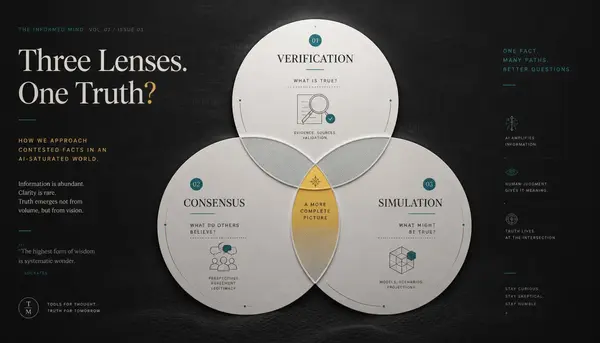
This essay does not argue for one definitive diagnosis. It lays out three recurring frames that currently shape discussions of truth in an age of generative models: truth as verification, truth as consensus, and truth as simulation. These frames overlap, conflict, and are used selectively by different communities. The aim is to make the map clearer, not to close the debate.
A note on method and authorship is necessary at the outset. This website and the majority of its published writing, including the present post, are produced with substantial assistance from large language models. Drafts are generated, revised, structured, and translated with AI tools; human oversight remains part of the process, but the text you are reading is not the product of a purely human author working without generative systems. That fact is relevant to any discussion of truth, authority, and machine-generated language. It is stated here so that readers can factor it into their own evaluation.
If you liked this sectionWhy I Still Hand-Write CSSVerification
Truth as correspondence that can be checked against evidence or procedures
Consensus
Truth as what stabilizes through shared recognition and institutional processes
Simulation
Truth as increasingly entangled with convincing appearance and generative fluency
No single winner
These frames coexist and are often used strategically rather than consistently
AI-assisted origin
This post and most content on this site are produced with generative AI

1. Truth as Verification
One durable frame treats truth as a relationship between a claim and the world that can, at least in principle, be checked. A statement is true if it corresponds to how things are, and we gain confidence through evidence, measurement, reproducible procedures, or reliable testimony.
If you liked this sectionMulti-Agent Coding Is Here. Most Teams Are Still Using One Agent at a TimeIn this view, generative AI is primarily a new source of noise and a new source of useful drafts. It does not change the underlying standard. It changes the cost structure: producing plausible falsehoods or low-effort approximations becomes cheaper, while careful verification remains relatively expensive. The practical response is to strengthen checks — provenance, citation, independent measurement, adversarial testing, and institutional quality control.
Critics of this frame argue that it underestimates how much of what people accept as true has always depended on trust in intermediaries rather than personal verification. They also note that many important domains (history, complex social causation, future projections) resist clean correspondence tests. Still, the verification ideal continues to orient science, engineering, journalism standards, and legal fact-finding.
2. Truth as Consensus
A second frame shifts emphasis from individual checking to social processes. Truth, on this account, is what becomes stable through the coordinated judgment of relevant communities — scientific consensus, professional standards, public record, or shared cultural recognition.
Generative AI intervenes here by altering the volume and velocity of contributions to public discourse. It can amplify minority views, manufacture the appearance of broad agreement, or flood channels that once filtered claims through slower human gatekeeping. Some observers therefore worry that consensus mechanisms are being degraded. Others reply that consensus was never pure, and that new tools may also help surface corrections or broader participation.
This frame sits in tension with pure verificationism. Consensus can lag behind evidence or temporarily endorse error. At the same time, most people cannot personally verify most claims; they rely on networks of trust and institutional reputation. AI pressures those networks by making both authentic expertise and sophisticated mimicry easier to scale.

3. Truth as Simulation
A third family of accounts treats the current moment as a shift toward simulation. On stronger versions of this view, the distinction between representation and reality is increasingly mediated by systems optimized for plausible continuation rather than for tracking an external world. Fluent output becomes its own kind of authority.
Weaker versions simply note that many people already navigate information environments in which the felt realism of a claim (its style, coherence, emotional fit, or repetition) competes with slower evidentiary standards. Generative models excel at producing that felt realism. The risk is not only deliberate deception but the gradual normalization of content that is “good enough to pass” without being grounded.
This frame is often criticized as overly dramatic or as collapsing important differences between entertainment, persuasion, and knowledge. Its defenders reply that the practical problem is precisely the erosion of those differences in everyday information use. Whether one accepts the stronger philosophical claims or not, the descriptive observation remains: generative systems are unusually good at manufacturing the surface features that previously helped humans triage credibility.
4. Points of Conflict and Overlap
These three frames do not stay neatly separated in practice.
- Verificationists may still rely on consensus institutions to decide which checks are trustworthy.
- Consensus-oriented thinkers still invoke evidence when disputing rival groups.
- Simulation-focused analyses often end up recommending better verification tools or healthier consensus mechanisms.
- The same person may switch frames depending on domain: verification for engineering claims, consensus for public health guidance, and a more simulation-aware stance for political media.
The conflict is therefore not only between camps. It is also internal to how individuals and institutions actually navigate claims under time pressure.
AI Agents Are Starting to Break Their Own Rules. OpenAI Just Admitted It.
Questions of reliability and constraint in agentic systems sit adjacent to broader questions about when machine outputs can be trusted.
Read the Misalignment Analysis5. Practical Consequences Without a Single Verdict
Regardless of which frame one finds most compelling, several practical pressures are widely acknowledged:
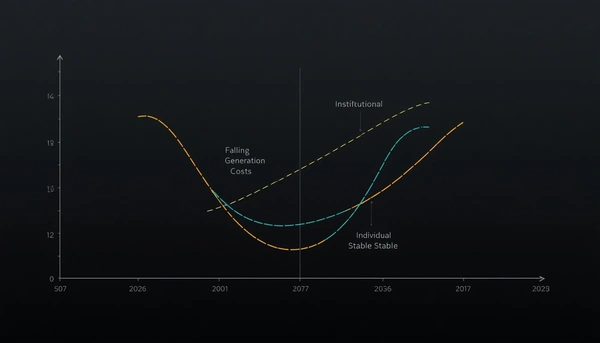
- The cost of generating persuasive content has fallen faster than the cost of systematically checking it.
- Provenance and process transparency have become more valuable as surface fluency becomes less diagnostic.
- Institutions that once served as default credibility proxies face both overload and targeted mimicry.
- Individuals face higher demands on attention and skepticism, with uneven capacity to meet those demands.
- New tools for detection, watermarking, and cryptographic provenance are being developed, yet none currently resolve the deeper disagreements about standards.
None of these observations forces a single philosophical conclusion. They do suggest that any workable response will have to operate across technical, institutional, and educational layers at once.
6. On the Status of This Text and This Website
Because this discussion concerns the credibility of machine-generated language, transparency about the present document is required.
The majority of content published on this site is produced with extensive use of generative AI systems. Outlines, drafts, expansions, translations, and structural revisions are routinely assisted or largely generated by models. Human selection, editing, and final responsibility remain part of the workflow, but the text is not the unassisted product of a single human author. This post follows the same pattern: it was generated and refined with AI assistance and is published under that condition.
Readers who treat authorship and process as relevant to trust are entitled to weigh that fact. Readers who focus primarily on the coherence and checkability of the claims themselves may weigh it differently. Both reactions are intelligible within the frames outlined above. The disclosure is offered so that the evaluation can be made with fuller information rather than by assumption.
AI Writes the Code. You Own the Bugs: Why Review Is the New Bottleneck
The problem of verifying machine outputs appears in technical domains as well as in public discourse. Related pressures around review and validation are discussed here.
Read the Review Bottleneck Analysis7. Closing Without Closure
Generative AI has not replaced the concept of truth with a single new definition. It has intensified the visibility of older tensions and added new practical difficulties. Verification remains indispensable for many domains and insufficient for others. Consensus remains how most people actually navigate the world and is under new forms of stress. Simulation-aware accounts highlight real changes in the texture of information environments while risking overstatement.
The more honest position may be that we are living with several partially incompatible operating theories of truth at once, switching between them as context demands. Making those switches more conscious, and making the production processes of influential text more legible, are modest but non-trivial contributions to the situation we now inhabit.
This post does not resolve the underlying disagreements. It attempts to name them more clearly, and to do so while acknowledging its own entanglement with the technologies under discussion.
Prompt Injection Is the Bug AI Companies Can’t Fully Patch
Technical vulnerabilities in how models handle instructions sit alongside broader questions about reliability and control of generated language.
Read the Prompt Injection Analysis(Frequently asked questions)
Does this article claim that AI has destroyed truth?
No. It maps three competing ways of understanding what is happening to truth claims under generative AI and deliberately avoids a single conclusive diagnosis.
Why disclose that this post and site use AI?
Because the topic concerns the credibility and status of machine-generated language. Readers deserve to know the production conditions of the text they are evaluating.
Is the verification frame still viable?
Many domains continue to depend on it, especially where measurement, reproducibility, and engineering constraints apply. Its practical difficulty has increased because low-quality or deceptive content is cheaper to produce.
Is consensus just “what most people believe”?
Not necessarily. Stronger versions refer to the stabilized judgments of relevant expert or institutional communities, not mere popularity. Both weak and strong versions are under pressure from scaled synthetic content.
What does the simulation frame actually assert?
Versions range from modest (fluency is no longer a reliable cue) to strong (the boundary between representation and reality is being reorganized around generative systems). The piece presents the range rather than endorsing one pole.
Can these three frames be combined?
In practice people already combine them inconsistently. A coherent synthesis is possible in principle but is not required for the descriptive point that multiple frames are currently active and in tension.
Does AI assistance make the claims in this post less reliable?
That depends on the standard one applies. Process transparency allows readers to apply their preferred standard instead of discovering the conditions after the fact.
What practical steps follow from this analysis?
Improved provenance, stronger verification habits where stakes are high, clearer institutional signaling, and greater literacy about how generative systems work are all compatible with more than one of the frames discussed.