Dead in the Water or a Real Loss? Sorting Fact From Spin in the Anduril Drone Capture
Dead in the Water or a Real Loss? Sorting Fact From Spin in the Anduril Drone Capture
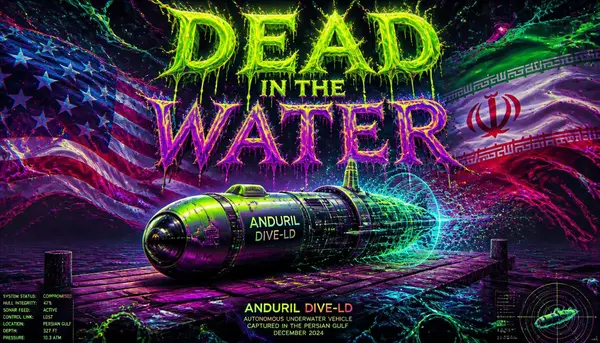
On September 8, 2026, Iran’s Islamic Revolutionary Guard Corps released photographs and video of a cylindrical, roughly 5.8-meter autonomous underwater vehicle lying on a pier. The craft bore clear Anduril markings. Within hours three incompatible stories were circulating: Iran’s claim of a sophisticated intelligence coup, CENTCOM’s description of a malfunctioning older model that had been “dead in the water” for more than a day, and Anduril’s insistence that the Dive-LD is an attritable system whose loss in contested waters is an expected design outcome.
This piece separates the verified technical and operational record from the competing public narratives. It draws on CENTCOM statements, Anduril and Palmer Luckey comments, Iranian releases, and independent reporting from DefenseScoop, Reuters, Janes, Army Recognition, and Military Times as of September 11, 2026.
Sep 8
Date IRGC publicly announced recovery of the Dive-LD near the Strait of Hormuz
>24 h
Time CENTCOM says the vehicle had already been malfunctioning and immobile before Iranian recovery
Apr 2025
First public delivery of Dive-LD units to U.S. Navy Unmanned Undersea Vehicle Group 1
~5.8 m
Length of the Dive-LD large-diameter AUV recovered intact by Iranian forces
Attritable
Anduril’s official classification of the Dive-LD design philosophy

1. What Was Actually Recovered
The vehicle is an Anduril Dive-LD, a large-diameter autonomous underwater vehicle originally developed by Dive Technologies and brought into the Anduril portfolio after the 2022 acquisition. Public specifications describe a modular platform approximately 5.8 meters long and 2.7–2.8 tonnes, capable of multi-day endurance and depths rated to 6,000 meters. Its primary advertised roles include hydrographic survey, mine reconnaissance, intelligence preparation of the operational environment, and precision payload placement.
Iranian imagery shows an intact hull, nose cone, flood holes, a short transparent forward mast, and X-form stern control surfaces. The starboard side marking appears as “DI E-LD,” consistent with partial obliteration or wear of the full “Dive-LD” identifier. Independent open-source analysts matched the visual details to known Dive-LD characteristics within hours of the IRGC release.
If you liked this sectionQwen3.8 vs Kimi K2.7 vs Gemma 4: Which Local Coding Model Fits Your GPU?CENTCOM’s first detailed statement, delivered by Navy Capt. Tim Hawkins, established three operational facts that have not been contradicted by subsequent reporting: the vehicle was an older model; it had malfunctioned more than a day earlier while conducting a survey mission in support of ongoing operations; and it carried neither classified sonar/radar suites nor sensitive collected data at the time of recovery.
2. The Competing Narratives
Iran framed the recovery as the successful interception of “one of the most modern, intelligent, and unmanned submarines of the terrorist American army.” The language is maximalist and designed for domestic and regional consumption. Iranian accounts emphasize a deliberate, complex intelligence and operational effort rather than the recovery of a already-disabled platform.
CENTCOM’s language is deliberately minimal and technical. The repeated phrase “dead in the water” is not poetic; it is a precise description of a vehicle that had lost propulsion and was no longer maneuvering or communicating effectively. By stressing that the unit was older, non-sensitive, and already failed, CENTCOM sought to deny Iran both technological prestige and intelligence value.
Anduril and founder Palmer Luckey occupied a third position. Luckey publicly described the Dive-LD as a “mass-produced attritable submarine” that had already delivered “thousands of hours” of successful operation in the CENTCOM area before capture. The company statement reinforced that the system was “explicitly designed to operate in environments too dangerous for humans where capture is an expected possibility.” In other words, the loss is not a failure of the concept; it is evidence the concept is being used as intended.
3. Technical Reality Versus Marketing Claims
Anduril has marketed the Dive-LD as one of the most reliable and flexible large AUVs available, with multi-day endurance and modular payload capacity. That marketing sits alongside the CENTCOM description of an older model that suffered a mission-ending malfunction. Both statements can be true at the same time: a platform can accumulate thousands of successful hours across a fleet and still experience individual unit failures, especially in the demanding acoustic, current, and temperature environment of the Strait of Hormuz approaches.
The absence of classified sonar or radar payloads is significant. It limits the immediate intelligence windfall for Iran to the vehicle’s mechanical design, navigation architecture, materials, and any residual non-sensitive software or logs. Reverse-engineering a hull, thruster arrangement, and basic autonomy stack is still valuable for an adversary developing its own undersea systems, but it is a narrower prize than the capture of a fully instrumented, data-rich platform would have been.
The Dive-LD also served as a testbed for Australia’s Ghost Shark program. Any detailed Iranian study of the recovered vehicle therefore has second-order implications for allied undersea autonomy development as well.

4. The Attritable Design Philosophy Under Pressure
Anduril’s core argument is that the Dive-LD was never intended to be a high-value, high-survivability asset. It belongs to the growing family of attritable systems — platforms cheap enough, and numerous enough, that individual losses are budgeted for rather than treated as strategic setbacks. In that framing, a single recovery by Iran is closer to the expected cost of doing business in contested littorals than to a catastrophic intelligence failure.
This philosophy is coherent only if the fleet is large enough and the individual unit cost low enough that losses do not constrain operations. Public reporting has placed unit cost estimates in the low millions of dollars. Whether that price point, combined with production rates, truly supports the attritable claim remains an open question that the September 8 incident will force both Anduril and its Navy customer to answer more transparently.
The incident also tests the political durability of the attritable concept. Domestic and allied audiences may accept the loss of a low-cost air drone far more readily than the intact recovery of a multi-ton underwater vehicle by a sophisticated adversary. Perception management is therefore part of the operational design, not an afterthought.
Prompt Injection Is the Bug AI Companies Can’t Fully Patch. Should You Worry?
Autonomous systems — whether undersea, aerial, or software agents — create new attack surfaces. The same logic that treats hardware as attritable must also confront software and data vulnerabilities.
Read the Prompt Injection Analysis5. Reverse-Engineering Risk: Real but Bounded
Iranian officials and affiliated accounts quickly signaled intent to study the vehicle. The opportunity is genuine. Even without classified sensors or recent mission data, the recovered Dive-LD provides physical access to hull form, propulsion, energy storage, navigation hardware, and whatever residual software or firmware remains. For a state already investing in undersea capabilities, that access accelerates learning.
At the same time, the risk is bounded by several factors. The vehicle was described as an older model. Critical high-end payloads were absent. Modern autonomous systems increasingly rely on frequent software updates and cloud-or-ship-based mission planning; a captured unit may therefore lag current fleet software. And the United States and Anduril can observe Iranian exploitation efforts and adjust future designs accordingly.
Historical precedent is mixed. Captured Western systems have sometimes yielded useful insights for adversaries and sometimes proven less transferable than hoped once the full software, training, and logistical ecosystem is missing. The Dive-LD case will likely fall somewhere in the middle: useful hardware lessons, limited immediate operational replication.
6. Operational Context in the Strait of Hormuz
The recovery occurred in one of the world’s most contested maritime chokepoints. U.S. forces have conducted persistent undersea survey and mine-countermeasure activity in the region. The Dive-LD’s stated mission — regional water survey in support of ongoing operations — fits that pattern. A disabled vehicle left immobile for more than a day in those waters was always at elevated risk of recovery by Iranian forces that maintain dense coastal and maritime domain awareness.
Whether U.S. forces attempted recovery or scuttling before Iranian arrival remains publicly unclear. The fact that an intact vehicle was presented suggests either that location was lost after the malfunction or that recovery assets could not reach the site in time without unacceptable risk. Both possibilities carry operational lessons for future unmanned undersea deployments in high-threat littorals.

7. Broader Implications for Autonomous Systems
The Dive-LD incident is a live test of the attritable thesis that underpins much of the current U.S. and allied push toward large numbers of lower-cost autonomous platforms. If losses of this type are truly expected and budgeted, then the public messaging must remain consistent and the production base must be able to absorb them without operational pause. If each intact recovery generates disproportionate political and intelligence cost, then the cost-exchange ratio shifts against the attritable model.
It also highlights the enduring tension between software-defined, frequently updated autonomy and the physical reality of a recoverable hull. Even when sensitive data is absent, the hardware itself becomes a teaching aid for the adversary. Designers of future undersea and aerial systems will need clearer policies on remote wipe, scuttling charges, and the acceptable residual intelligence value of a captured unit.
Finally, the episode underscores that narrative control is now an integral part of unmanned operations. CENTCOM’s rapid, precise language about “dead in the water” and the absence of classified payloads was an attempt to shape the information environment as much as to convey facts. Anduril’s attritable framing served the same purpose. Iran’s maximalist claims did the opposite. In the age of ubiquitous imagery, the first coherent technical explanation often becomes the enduring public record.
Your AI Tools Are Spying on You. Here’s the Fix.
Autonomous systems — undersea or software — collect and retain data by design. Understanding residual data risk after loss or capture is as important as understanding the hardware itself.
Read the Local AI Privacy Guide8. Sorting the Spin — A Clear Ledger
- **Verified**: An older Anduril Dive-LD malfunctioned, remained immobile for more than 24 hours, and was recovered intact by Iranian forces near the Strait of Hormuz on or about 8 September 2026.
- **Verified**: CENTCOM states the vehicle carried no classified sonar/radar and no sensitive collected data at recovery.
- **Verified**: Anduril and Luckey classify the Dive-LD as attritable and note prior successful operating hours in the theater.
- **Claim (Iran)**: The vehicle represents one of the most advanced U.S. unmanned submarines and the result of a deliberate complex operation. This is maximalist framing inconsistent with the CENTCOM technical description.
- **Claim (Anduril)**: Loss in such environments is an expected design outcome. This is coherent with the attritable philosophy but requires sustained production and political acceptance to remain credible.
- **Open**: Exact cause of the malfunction, whether recovery or scuttling was attempted, residual software state, and the concrete reverse-engineering value Iran will extract.
The most accurate current description is therefore this: a real but limited operational loss of an attritable system that had already delivered value, occurring under conditions that made recovery by a capable adversary probable once mobility was lost. It is neither a catastrophic intelligence disaster nor a trivial non-event. It is the visible cost of operating large autonomous undersea vehicles in one of the world’s most contested waterways.
9. What to Watch Next
Three indicators will clarify the lasting significance of the incident. First, whether Anduril and the Navy adjust Dive-LD employment, recovery procedures, or scuttling protocols in the CENTCOM area. Second, the volume and specificity of Iranian technical claims or derivative systems that appear in the coming months. Third, whether the political and budgetary reaction inside the United States treats the loss as validating or undermining the attritable model.
Until those signals emerge, the cleanest reading of the available evidence remains the one CENTCOM offered on day one: the vehicle was already dead in the water. Everything else is interpretation layered on top of that operational fact.
OpenAI Just Cut Off Cursor. What This Means for AI Coding in 2026
Autonomy — whether undersea or in software agents — increasingly depends on commercial partnerships that can be revoked or disrupted. The same questions of resilience and fallback apply across domains.
Read the Cursor Cutoff Analysis(Frequently asked questions)
What exactly did Iran recover?
An Anduril Dive-LD large-diameter autonomous underwater vehicle. CENTCOM described it as an older model that had malfunctioned more than a day earlier while conducting a survey mission. Iranian imagery shows an intact hull consistent with known Dive-LD visual characteristics.
Did the vehicle carry classified sensors or sensitive data?
According to CENTCOM spokesperson Navy Capt. Tim Hawkins, the recovered Dive-LD neither collected sensitive data nor carried any classified sonar or radar equipment at the time of recovery.
Why does Anduril call the Dive-LD “attritable”?
Anduril designed the system to operate in environments too dangerous for manned platforms, accepting that individual vehicles may be lost or captured. Palmer Luckey publicly described it as a mass-produced attritable submarine that had already delivered thousands of operating hours before this incident.
How long had the Dive-LD been in U.S. Navy service?
The first public deliveries to the Navy’s Unmanned Undersea Vehicle Group 1 occurred in April 2025. The recovered unit had therefore been available for roughly 17 months of potential operations by the time of the September 2026 incident.
Is reverse-engineering a serious risk?
Yes, but bounded. Iran gains physical access to hull, propulsion, navigation hardware, and residual software. The absence of classified payloads and the vehicle’s status as an older model limit the immediate high-end intelligence value, yet mechanical and architectural lessons remain useful for Iranian undersea programs.
Was the vehicle deliberately left for Iran to find?
No public evidence supports that interpretation. CENTCOM’s account is that the vehicle malfunctioned and remained immobile for more than 24 hours. Whether U.S. forces attempted recovery or scuttling before Iranian arrival has not been detailed in open sources.
Does this incident invalidate the attritable systems concept?
Not by itself. A single loss of a lower-cost autonomous vehicle in a high-threat environment is consistent with the design philosophy, provided the production base and political acceptance can absorb such events without operational pause. The coming months of force posture and budget reaction will be more informative than the recovery itself.
What is the Dive-LD primarily used for?
Public descriptions list hydrographic survey, mine reconnaissance, intelligence preparation of the operational environment, ISR support, and precision payload placement. The CENTCOM statement placed this particular vehicle on a regional water survey mission.