From Clicks to Conversations: Why Your Content Strategy is Obsolete

The era of optimizing for clicks is over. AI agents don't browse — they converse. If your content strategy still measures success by traffic volume, you're building for a web that no longer exists. Here's what to do instead.
From Clicks to Conversations: Why Your Content Strategy is Obsolete
For two decades, the web ran on a simple equation: publish content, rank for keywords, attract clicks, convert visitors. That equation is now broken. In 2026, 64.82% of all Google searches end without a single click to the open web. The user gets the answer — they just never visit your site to get it.
This isn't an algorithm update you can recover from. It's a structural shift in how information is discovered, synthesized, and consumed. The web is transitioning from a click-based economy — where traffic was the primary currency — to a conversation-based economy, where AI agents talk to users on your behalf, and your brand's visibility depends entirely on whether those agents cite you.
If you liked this sectionContent Clusters for GEO: How to Build Topical Authority That AI Engines TrustIf your content strategy still revolves around rankings, keyword volume, and traffic growth, it's not just outdated — it's obsolete. Here's why, what the data shows, and what you need to build instead.
What 'Content Strategy' Used to Mean
The traditional content strategy was built around the funnel. Top-of-funnel content attracted broad audiences through informational keywords. Middle-of-funnel content nurtured interest. Bottom-of-funnel content closed conversions. Every piece had a job: move the user from awareness to action, with clicks as the primary metric of success.
This model worked because search engines were directories. They pointed users to destinations. A click was a referral — a signal that the search engine had matched a query to a relevant result, and the user was willing to leave the results page to explore it.
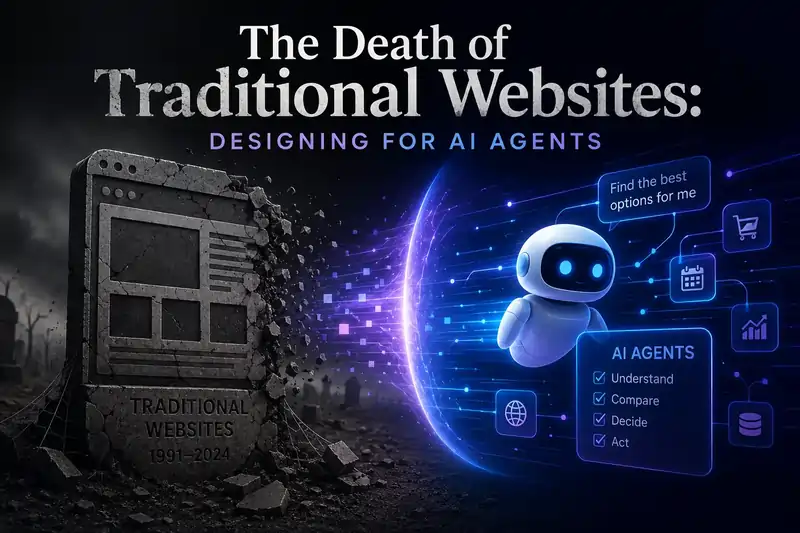
If you liked this sectionThe Death of Traditional Websites: Designing for AI AgentsBut that model depended on a fundamental assumption: that users would need to visit your site to get the answer. AI Overviews, featured snippets, knowledge panels, and direct answer boxes have invalidated that assumption entirely. The user no longer needs to visit your site to get your information. They can get it directly on the search results page — with your brand mentioned but without the traffic.
The traditional marketing funnel — awareness, consideration, conversion — assumed users would progressively interact with your content. In the AI era, the awareness stage happens entirely on the SERP. Users form perceptions of your brand based on AI Overviews before they ever visit your site. If your content strategy doesn't account for this, you're invisible at the moment of first impression.
The Conversation-Based Content Model
The replacement for the funnel is a conversation-based model. In this model, you create content that AI systems can extract, synthesize, and cite — and you measure success by citation frequency, not click volume.
When a user asks an AI agent a question, the agent synthesizes a response from multiple sources. It doesn't select sources based on ranking position alone. It selects based on authority, relevance, verifiability, and structural clarity. A page that provides a clear, citable answer with named sources and original data is far more likely to be cited than a page that relies on brand authority alone — even if that page ranks higher.
This means the new content strategy has three pillars: citation density, topical depth, and answer-first structure. Let's break each down.
The goal is no longer to get users to your site. The goal is to get your site into the AI's response. The click is optional; the citation is essential.
1. Citation Density: Making Every Fact Count
Citation density is the measure of how many verifiable, specific, and directly answerable claims a piece of content contains. High citation density content looks like this: a direct answer to a question within the first 150 words; specific statistics with named sources (e.g., 'Seer Interactive's 2026 analysis of 25.1 million impressions found...'); clear headings that mirror common query structures ('What is X?', 'How does Y work?'); and structured elements like FAQ blocks, comparison tables, and step-by-step instructions.
Low citation density content looks like this: long introductory paragraphs that build context before delivering the answer; generalized claims without specific sources ('experts agree that...'); lengthy prose without subheadings; and content that is gated behind JavaScript or user interaction. AI models skip this content because it doesn't fit the pattern of what a citable source looks like.
If your content is not structured for extraction, it will not be extracted. AI models are pattern-matching engines — they cite what they can parse. Make it parseable.