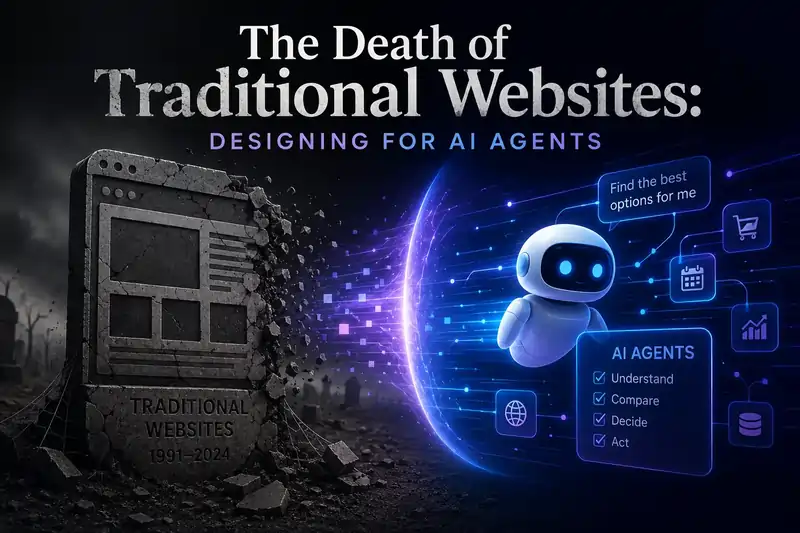
The Death of Traditional Websites: Designing for AI Agents
Your Next Visitor Won't Have Eyes
The web was designed for humans. Every visual decision — the hero image, the color hierarchy, the smooth page transition — assumes a pair of eyes moving across a screen. That assumption is breaking down. In 2026, a growing share of web traffic comes from AI agents: autonomous systems that browse, read, and extract information from websites on behalf of users who never visit at all.
When an AI agent visits your site, it does not render your design. It parses your HTML, strips the navigation, ignores the JavaScript animations, and extracts the text your server returns. A 500 KB page of layout code and tracking scripts becomes noise. A Gartner-cited projection suggests that by 2026, up to 25% of searches are being delegated to AI assistants rather than typed into a search engine directly. The user asks ChatGPT a question; ChatGPT visits your site and decides whether you are worth citing. You never appear in the loop at all.
This is not a hypothetical future. It is the present condition of the web. And it demands a fundamental rethink of what a website is for, how content is structured, and what 'good design' means when your most important visitor is a language model operating in inference mode.
If you liked this sectionContent Clusters for GEO: How to Build Topical Authority That AI Engines Trust60%+
of searches now end without a click to any website
83%
zero-click rate when an AI Overview appears in results
40%
visibility lift from structured, GEO-optimized content (Princeton research)
90%
reduction in token usage from clean llms.txt implementation
How AI Agents Read Your Website
Understanding the technical reality of how AI agents consume web content is the starting point for designing with them in mind. The process is fundamentally different from how a human or even a traditional search bot engages with a page.
When a system like Perplexity, ChatGPT Search, or an autonomous browser agent visits a URL, it fetches the server-rendered HTML and converts it to a token-efficient format — usually Markdown or plain text. Raw HTML is expensive: a single web page can contain 500 KB of code, the vast majority of which is styling, layout divs, tracking scripts, and navigation boilerplate that contributes zero information value to the model. Tools like Firecrawl convert websites into clean Markdown that is 5 to 10 times more token-efficient than raw HTML, which is why clean semantic structure is now directly tied to whether an AI agent can extract your content within its context window budget.
If you liked this sectionFrom Clicks to Conversations: Why Your Content Strategy is ObsoleteAI agents do not browse linearly. They are executing a plan. The agent receives a user query, fans it out into sub-queries, fetches relevant pages, extracts the passages with the highest information density, and synthesizes them into a response. Your content competes not for a click, but for inclusion in that synthesis. The agent decides in milliseconds whether your page contains something worth injecting into its context. If your key information is buried behind a JavaScript accordion, locked behind a login, or scattered across navigation-dependent multi-page flows, the agent leaves empty-handed.
Ollama: The Engine Behind Local AI
Understanding the infrastructure that powers AI agents is essential. Our deep dive into Ollama covers the inference engine behind many local AI systems.
Read About OllamaOpen WebUI: The Missing Interface for Local AI
See how AI interfaces are evolving with Open WebUI — the open-source platform that wraps Ollama in a ChatGPT-class experience.
Explore Open WebUIThe Zero-Click Economy and What It Means for Your Traffic
The data on zero-click search is no longer a trend to monitor — it is the current operating condition of the web. By early 2026, over 60% of all standard search queries end without a single click to any external website. When an AI Overview appears in results, that rate spikes to 83%. Google's AI Overviews now appear on roughly 55% of all search queries globally.
The impact is concrete. Businesses holding top-three organic positions on competitive keywords reported 30 to 60% traffic declines in 2025 — not because their rankings dropped, but because the AI intercepted the answer and the user never needed to click. The $80 billion global SEO industry is being restructured around a new objective: not the click, but the citation. If a language model cites your content as the source for an answer, your brand appears in front of the user without a visit. The metric that matters is no longer position one — it is mention rate across thousands of AI-generated responses.
Generative Engine Optimization: The New Design Requirement
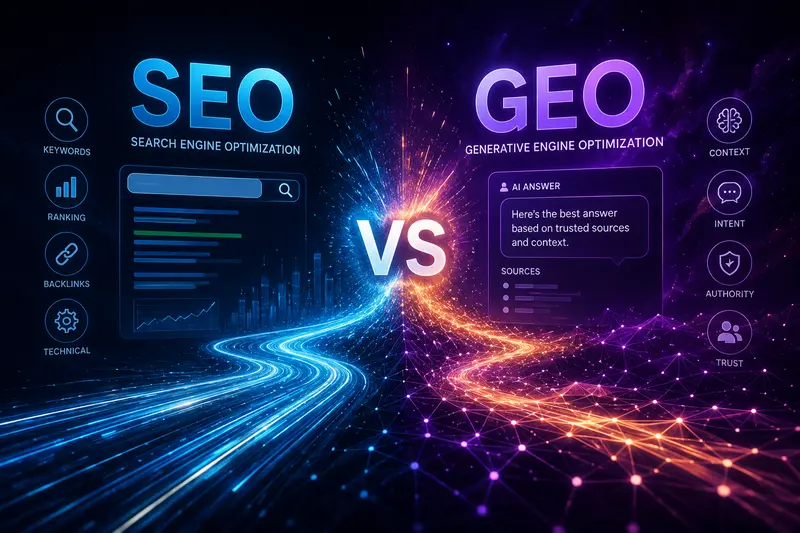
Generative Engine Optimization is the practice of structuring content so it is retrieved, understood, and cited by large language models. GEO builds on traditional SEO's technical foundations — crawlability, authority, relevance — but adds a layer of requirements that have no equivalent in the old playbook.
The first requirement is information density over keyword density. LLMs are trained to prioritize what researchers call 'Information Gain' — new, unique, verifiable insights that cannot be found elsewhere on the web. A page that restates commonly available information and buries it in marketing language is less likely to be cited than a page that leads with a specific, citable fact in its first paragraph. The Princeton and Georgia Tech research team found that content strategies optimized for information density increased AI search visibility by up to 40%.
The second requirement is hierarchical clarity. LLMs parse heading structure as a content map. A page with clear H1, H2, and H3 hierarchies — one topic per section, a direct answer leading each section before context follows — gives a model a reliable extraction grid. A page where important information is embedded in long prose blocks with no structural signaling requires the model to work harder, consuming more tokens, and risks the key content being missed or misattributed.
The third requirement is factual verifiability. AI models treat user-generated content, third-party citations, and external references as 'ground truth' signals that reduce the probability of their own hallucination. A page that supports its claims with specific statistics, named sources, and external links builds what GEO practitioners call a 'source stack' — a trust hierarchy that makes the model more confident in extracting and citing your content.
- Lead every section with a direct answer — context follows, it does not precede
- Use H1/H2/H3 hierarchies with one topic per heading, not decorative headings
- Write in scannable formats: bullet points, numbered lists, short declarative paragraphs
- Support every claim with a specific statistic, date, or named source
- Ensure all key content is server-side rendered, not JavaScript-dependent
- Verify AI crawlers are not blocked in robots.txt or by Cloudflare default rules
- Build FAQ sections — these map directly to how LLMs process conversational queries
Structured Data: Schema Markup as Machine Grammar
Structured data is not a new concept — JSON-LD schema markup has been part of technical SEO practice for a decade. In the context of AI agents, it has become something closer to essential infrastructure. Schema markup removes the ambiguity that forces a language model to guess. When your FAQ items are tagged with FAQPage schema, the model does not have to infer they are questions. When your product has an offer price tagged with Product schema, the model does not risk inventing a number.
The schema types with the highest practical impact for AI visibility in 2026 are FAQPage (for conversational query matching), Article and BlogPosting (for editorial authority signals), Organization and Person (for entity disambiguation), Product and Offer (for commercial queries), and BreadcrumbList (for contextualizing where a page sits within a site's information hierarchy). Each of these gives the model a structured fact it can extract without inference — and facts that require no inference are the ones that end up in citations.
<!-- Example: FAQPage JSON-LD for GEO optimization -->
<script type="application/ld+json">
{
  "@context": "https://schema.org",
  "@type": "FAQPage",
  "mainEntity": [
    {
      "@type": "Question",
      "name": "What is Generative Engine Optimization?",
      "acceptedAnswer": {
        "@type": "Answer",
        "text": "GEO is the practice of structuring web content so it is retrieved, understood, and cited by large language models in AI-generated search answers."
      }
    },
    {
      "@type": "Question",
      "name": "What is a zero-click search?",
      "acceptedAnswer": {
        "@type": "Answer",
        "text": "A zero-click search is one where the user receives a complete answer within the search interface — from an AI Overview or chatbot — and never clicks through to any external website."
      }
    }
  ]
}
</script>llms.txt: The robots.txt of the AI Era
The llms.txt standard is a Markdown file placed at the root of your website — yoursite.com/llms.txt — that tells large language models what your site is, what its most important pages are, and how to represent your content accurately. Think of it as robots.txt for intent rather than access: robots.txt tells crawlers where not to go; llms.txt tells models where the most valuable content lives.
The format is intentionally lean. An H1 with the site name. A blockquote with a two-to-three sentence description that becomes the model's 'mental model' of your brand. Sections for key content areas, each with links and brief descriptions of what the model will find. An FAQ section embedded directly in the file, so the model can answer common queries about your business without even fetching sub-pages. Companies like Anthropic, Stripe, Vercel, and Cloudflare have already implemented llms.txt. Implementation case studies show that a well-structured llms.txt file can reduce an AI agent's token consumption by up to 90% while dramatically increasing the accuracy of how models represent the site — reducing hallucinations about pricing, policies, and product details.
The file is not yet a W3C or IETF official standard, but adoption has been rapid enough that practitioners in the GEO space describe it as becoming as foundational as sitemap.xml within the next year. The strategic logic is straightforward: without llms.txt, a language model builds its understanding of your site from whatever fragments it finds. With it, you control the narrative your site projects into the AI layer of the web.
Just as designers learned to design for the web, then for mobile, we now have to design for the generative interface. Your first impression is no longer your homepage — it is how a model decides to compress you into a sentence.
Content Architecture for Machine Readers
The most significant change AI agents impose on web design is not visual — it is architectural. Information that was previously buried behind navigation menus, progressive disclosure patterns, or multi-step user flows becomes inaccessible to a machine that cannot click, scroll, or wait for a hover state to reveal content.
For web designers, this creates a productive constraint: the best architecture for an AI agent is also the best architecture for a human who is in a hurry. Content that leads with the answer, uses clear hierarchy, avoids burying key facts in interstitial modals, and does not require ten clicks to reach a policy page is simply better content — for both audiences. The discipline of designing for machine readers tends to produce pages that are faster, clearer, and more useful for human readers too.
The specific patterns that degrade machine readability are worth naming explicitly: infinite scroll that delays content loading, JavaScript-gated content that only appears after interaction, navigation-dependent information hierarchies where the context required to interpret a page only exists in the site's menu structure, and dark patterns that bury key information (pricing, limitations, policy terms) behind multiple steps. All of these were already problems for human readers. AI agents have simply made the cost of them measurable.

What This Means for Visual Web Design
A reasonable conclusion from everything above is that visual web design no longer matters. That conclusion is wrong — but the argument for it contains a real insight worth engaging with directly.
Visual design matters profoundly for the users who do arrive on your site. As zero-click search filters out the users who only needed a quick answer, the visitors who click through to a page are increasingly in a decision or evaluation phase. Research suggests that AI-referred visitors convert at up to 4.4 times the rate of traditional organic search visitors. The quality of the visual and interaction design that greets those visitors directly affects whether that conversion happens. A site that is GEO-optimized to be cited but visually incoherent when visited is only solving half the problem.
What changes is the priority order. Visual design is now downstream of content architecture. A beautiful site with content that AI agents cannot read will become invisible faster than a plain site with clearly structured, citable information. The design discipline that is hardest to separate from GEO is not visual — it is structural. Information architecture, content hierarchy, semantic HTML, and the elimination of extraction barriers are the design decisions that determine AI visibility. Visual execution determines what happens after a user arrives.
Design Without Words Is Decoration
Explore the philosophical side of design decisions and why visual communication must serve a purpose beyond aesthetics.
Read About Design PrinciplesModern Techniques in Frontend Design
Learn the technical patterns that make content both human-readable and machine-accessible in modern web development.
Explore Frontend TechniquesConclusion: Design for Both Audiences
The web now has two distinct audiences with fundamentally different reading patterns. Human users interpret visual hierarchy, respond to emotional design, and navigate through progressive disclosure. AI agents parse semantic structure, extract factual density, and evaluate machine readability in milliseconds.
The websites that will survive and compound in the AI-first web are those designed for both simultaneously. Semantically clean HTML that renders beautifully. Information that leads with answers and follows with context. Structured data that removes ambiguity for models and adds rich snippets for human scanners. An llms.txt that controls the narrative projected into AI systems. Visual design that converts the high-intent visitors who click through from an AI citation.
This is not the death of web design. It is its expansion into a dimension that was always there but never mattered until now. The designers and developers who understand both audiences will build the most durable, visible, and effective sites of the next decade. Those who optimize for only one will find themselves progressively invisible to the other.
Schema.org — Structured Data Vocabulary
The official schema.org documentation provides the complete vocabulary for JSON-LD structured data. Understanding these types is essential for implementing the FAQPage, Article, and BreadcrumbList schemas discussed in this article.
Visit Schema.orgllms.txt Specification
The llms.txt standard is gaining adoption across the web. Learn how to implement this token-efficient Markdown file that gives AI models a clear map of your site's most valuable content.
Learn About llms.txtOpen WebUI — Open Source AI Interface
Open WebUI is the most actively maintained open-source frontend for local LLM inference. See how it wraps Ollama with RAG, multi-user access control, and a ChatGPT-class interface.
Explore Open WebUIFirecrawl — Convert Websites to Clean Markdown
Firecrawl is the tool that converts any website into clean, token-efficient Markdown. It is the practical implementation of the extraction principles discussed in this article — 5 to 10 times more efficient than raw HTML for AI consumption.
Try FirecrawlPrinceton Research on AI Search
The Princeton and Georgia Tech research on information density and AI search visibility provides the empirical foundation for the GEO strategies outlined in this article.
Read the Research(Frequently asked questions)
What is Generative Engine Optimization (GEO)?
GEO is the practice of structuring web content so it is retrieved, understood, and cited by large language models in AI-generated search answers. Unlike traditional SEO, which optimizes for keyword rankings in a list of links, GEO optimizes for citation frequency in synthesized AI responses from systems like ChatGPT, Perplexity, and Google AI Overviews.
What is a zero-click search?
A zero-click search is one where the user receives a complete answer within the search interface — from an AI Overview, a chatbot, or a generative answer engine — without clicking through to any external website. By 2026, over 60% of all searches end this way, with the rate rising to 83% when an AI Overview appears in results.
What is llms.txt and why does it matter?
llms.txt is a Markdown file placed at the root of a website that provides large language models with a structured, token-efficient map of the site's content and identity. It functions like robots.txt — but rather than controlling access, it controls representation. Implementing it can reduce AI token consumption by up to 90% and dramatically improve how accurately models describe your brand, reducing hallucinations about pricing, policies, and products.
Does visual web design still matter in the age of AI agents?
Yes — but its role has shifted. Visual design is now downstream of content architecture. AI agents that cannot read your content will not cite it, making GEO optimization the prerequisite. But the human visitors who do arrive via AI citations are typically high-intent, and research shows they convert at up to 4.4 times the rate of traditional search visitors — making visual and interaction design more consequential, not less, for the users who actually see it.
Why does client-side rendering hurt AI visibility?
AI crawlers read the HTML your server returns. Content that only appears after JavaScript executes — common in React, Vue, and Angular applications using client-side rendering — may be completely invisible to the model. Key content, headings, and structured data need to be present in the server-rendered HTML to be accessible to AI agents visiting your site.