Cline: The Open-Source AI Coding Agent Redefining Developer Workflows
What Cline Actually Is
Cline is an open-source AI coding agent that operates as a VS Code extension, CLI tool, and embeddable SDK. Unlike traditional autocomplete tools or simple chat interfaces, Cline functions as a true collaborative agent: it reads your entire project context, plans multi-step tasks, executes file edits, runs terminal commands, browses the web when needed, and iterates based on feedback — all with explicit human-in-the-loop approval.
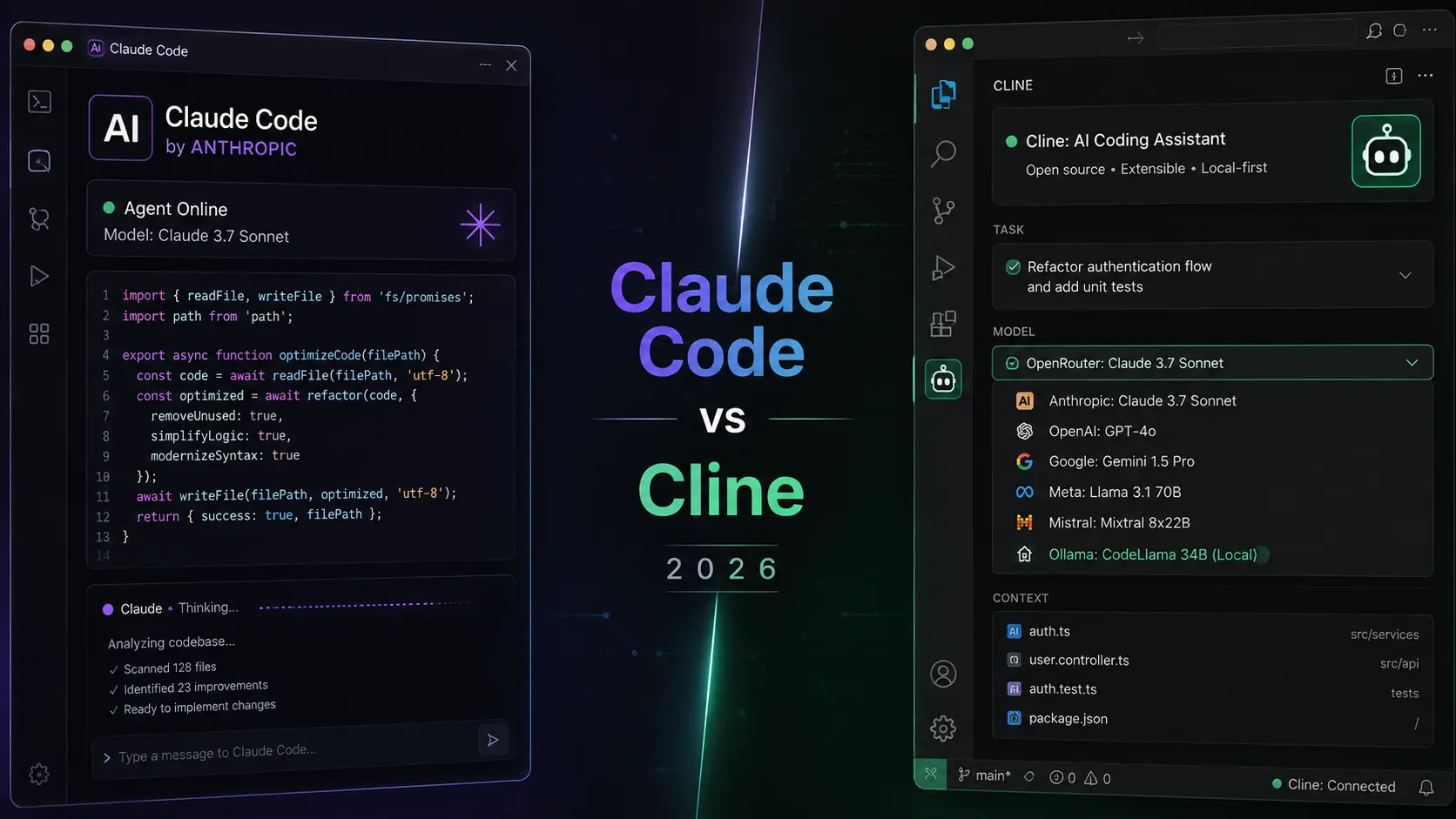
Built as a model-agnostic platform, Cline supports everything from frontier cloud models (Claude, GPT, Gemini) to fully local inference via Ollama or LM Studio. This flexibility makes it one of the most versatile tools for developers who want both cutting-edge capability and complete data privacy.
- Open-source (Apache 2.0) AI coding agent
- Native VS Code extension with deep IDE integration
- CLI for terminal and scripting workflows
- SDK for embedding in custom tools and products
- Full support for local models via Ollama and LM Studio
Why Agentic Coding Tools Matter in 2026
The evolution from code completion (Copilot-style) to full agentic workflows represents a fundamental shift in developer productivity. Cline excels here by combining persistent project memory, multi-file editing with linter awareness, version checkpoints, and one-click undo — turning vague prompts into production-ready implementations.
In an era of increasingly complex codebases, tools like Cline reduce context-switching and boilerplate work, allowing engineers to focus on architecture and problem-solving. Its open-source nature and local-first capabilities address growing concerns around vendor lock-in, data privacy, and API costs.
If you liked this sectionOpen WebUI: The Missing Interface for Local AIThe Evolution of AI Coding Tools
To understand Cline's significance, it helps to see where we've been. The first generation of AI coding tools were essentially autocomplete on steroids — they predicted the next token based on patterns, useful but limited. The second generation introduced chat interfaces, letting developers ask questions and get code snippets. Cline represents the third generation: autonomous agents that can plan, execute, and iterate.
- Generation 1: Autocomplete and inline suggestions (Copilot, TabNine)
- Generation 2: Chat-based assistants (ChatGPT, Claude in IDE)
- Generation 3: Autonomous agents with tool use (Cline, Devika, OpenHands)
Explore Modern Frontend Design Techniques
Learn how modern frontend design has evolved from static pages to interactive applications.
Read the ArticleThe best developer tools don't just automate tasks — they amplify human capability while preserving human judgment.
Architecture: How Cline Works
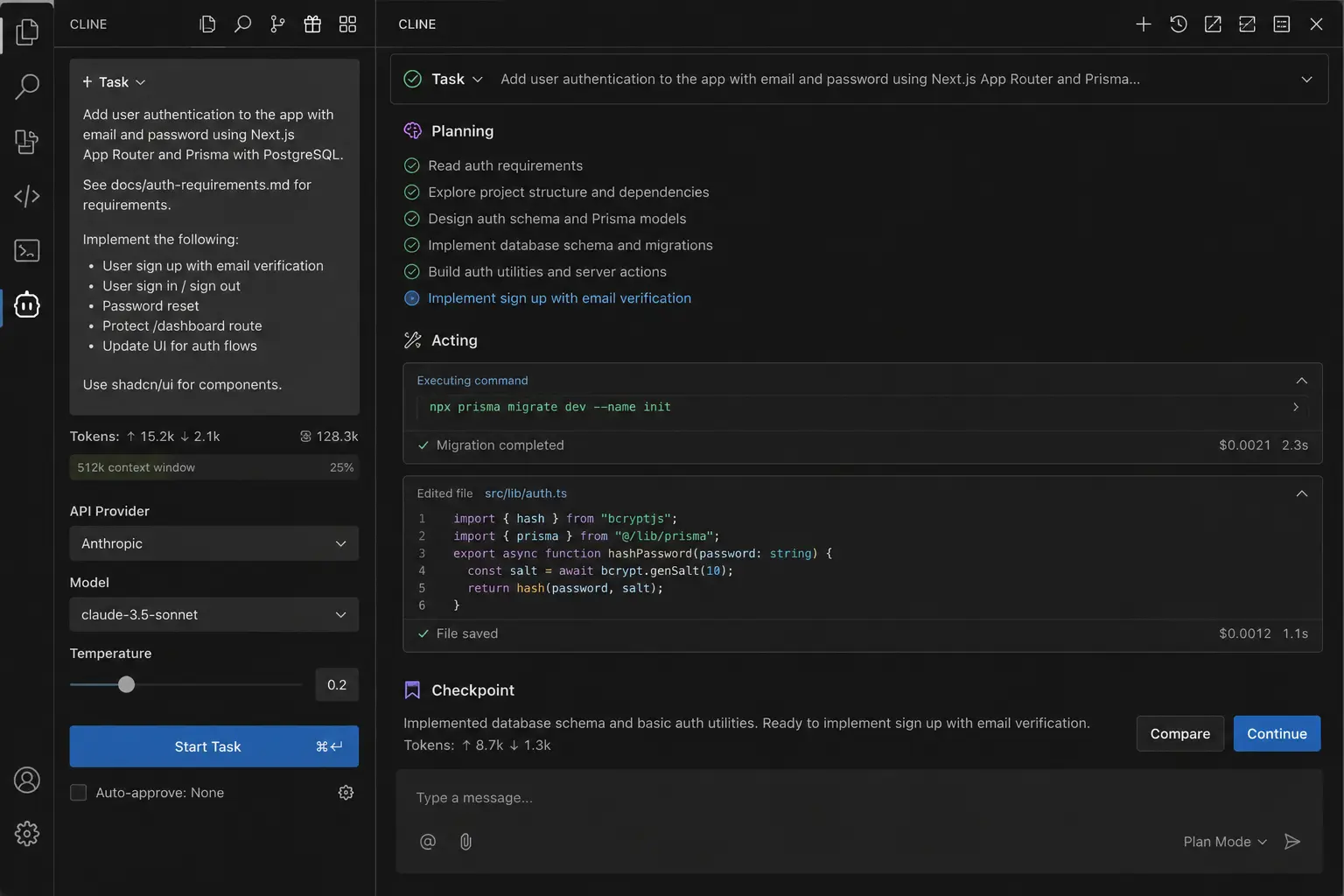
At its core, Cline uses a Plan/Act cycle. In Plan mode, the agent analyzes the task, breaks it down into steps, and proposes a strategy. Once approved, it moves to Act mode to implement changes. This separation prevents hallucinated actions and improves reliability on complex tasks.
Cline maintains rich context through project indexing, file relationships, and conversation history. It can execute shell commands, read/write files with precise diffs, handle git operations, and even use browser tools for research. The MCP (Model Context Protocol) integration allows extending capabilities with custom tools and plugins.
8M+
Developers worldwide
250+
Model contributors
100%
Local model support
- Plan/Act modes for structured reasoning
- Deep filesystem and terminal access with approval gates
- Persistent memory and project-aware context
- Linter-aware multi-file edits with checkpoints
- MCP for custom tool extensions
Plan Mode vs Act Mode: Understanding the Workflow
The Plan/Act distinction is more than a UI pattern — it's a fundamental architectural decision that dramatically improves reliability. In Plan mode, Cline thinks before it acts. It analyzes your codebase, identifies dependencies, considers edge cases, and presents a clear roadmap. This gives you, the developer, a chance to course-correct before any changes are made.
Act mode is where execution happens. Cline implements the plan step-by-step, showing you each change before applying it. It runs tests, checks for linting errors, and validates that its changes don't break existing functionality. If something goes wrong, you can roll back to any checkpoint with a single click.
Integration with Local LLMs and Ollama
Discover Ollama: The Engine Behind Local AI
Learn how to set up and use Ollama for private, offline AI development with Cline.
Read the GuideSetup is straightforward: install Ollama, pull a model like Qwen2.5-Coder or DeepSeek-Coder, then configure Cline to use the local endpoint. This combination delivers a completely offline, high-performance coding agent. Performance scales with hardware — Apple Silicon users benefit from unified memory, while GPU users see significant speedups through layer offloading.
The local-first approach isn't just about privacy — it's about reliability and cost. Cloud APIs can go down, rate-limit you, or charge you per token. A local model runs at your pace, on your hardware, with no external dependencies. For teams working on sensitive codebases or iterating rapidly on prompt design, this independence is invaluable.
Practical Use Cases and Workflows
Cline shines in real-world scenarios: large-scale refactoring, implementing new features from specs, debugging complex issues, generating tests, and even full application scaffolding. Developers report dramatic productivity gains when using it for boilerplate-heavy or exploratory coding.
Consider a typical refactoring task: updating a legacy authentication system to use modern JWT patterns. This might involve touching dozens of files across multiple directories, updating type definitions, modifying API endpoints, and ensuring backward compatibility. A human developer might spend hours navigating the codebase, understanding dependencies, and making careful edits. Cline can plan the entire transformation, execute it file by file, run tests after each change, and present you with a complete diff for review.
Cline turned a five-hour manual refactoring task into a 30-minute guided session where I stayed in the driver’s seat.
- Large-scale refactoring with dependency awareness
- Feature implementation from specification documents
- Automated test generation and coverage improvement
- Bug investigation across multiple files and modules
- Documentation generation from code analysis
The Human-in-the-Loop Advantage
What sets Cline apart from fully autonomous coding agents is its commitment to human oversight. Every significant action requires your approval. This isn't a limitation — it's a feature. In a world where AI tools increasingly make decisions without human input, Cline's approach ensures you remain the architect while the AI handles the implementation details.
Read: Design Without Words is Decoration
Explore the philosophy that form without function is just decoration.
Read the ArticleReady to Try Cline?
Install the VS Code extension and connect it to your local Ollama setup for private, powerful AI coding.
Get Started with Cline// Example: Prompt Cline to implement a feature
// Cline will plan, edit multiple files, run tests, and iterate
// 1. Describe your goal in plain language
// 2. Review the proposed plan in Plan mode
// 3. Approve to enter Act mode
// 4. Review each change as it's applied
// 5. Roll back if needed using checkpointsChoosing the Right Model for Cline
Model selection is critical. For speed and cost, smaller local models work well for routine tasks. For complex reasoning, frontier models via API or larger local quantizations deliver better results. Cline's flexibility lets you switch providers mid-task.
The model you choose should match the task at hand. Simple refactoring, boilerplate generation, and documentation tasks can run efficiently on smaller models like Qwen2.5-Coder-7B or DeepSeek-Coder-6.7B. Complex architectural decisions, algorithm design, and debugging intricate issues benefit from larger models like Claude 3.5 Sonnet or GPT-4o via API, or their local equivalents at higher quantization levels.
- Local (Ollama): Privacy, zero cost, offline capability
- Cloud (Claude/GPT): Superior reasoning on hard problems
- Hybrid: Use small local model for routine tasks, large models for complex steps
Security, Operational Considerations, and Best Practices
While local deployment minimizes external risks, treat Cline like any powerful tool. Review changes carefully, especially when granting terminal or filesystem access. Use checkpoints and git integration for safety.
The approval gates Cline provides are your first line of defense, but they work best when combined with good operational practices. Always review diffs before applying changes, especially for security-sensitive code. Combine Cline with git for easy rollbacks — each checkpoint creates a natural commit point. Monitor resource usage when running multiple large models concurrently, as memory pressure can affect performance.
- Always review diffs before applying changes
- Combine with git for easy rollbacks
- Monitor resource usage with multiple large models
- Use local models for sensitive codebases
- Set appropriate approval gates for terminal commands
The Business Case for Agentic Coding
Beyond individual productivity, Cline represents a shift in how teams approach software development. The cumulative time saved across a team — reduced boilerplate, faster onboarding, consistent code quality — translates to significant business value. But the real advantage is cognitive: developers spend less mental energy on routine tasks and more on creative problem-solving.
5x
Faster refactoring cycles
60%
Reduced boilerplate work
3x
Faster new developer onboarding
Explore Modern Frontend Design Techniques
Learn how modern frontend design emphasizes component reusability and design systems.
Read the ArticleConclusion: The Future of Coding is Agentic and Open
Cline represents the maturation of AI coding tools — open, flexible, and deeply integrated into developer environments. Whether you're running fully local with Ollama or leveraging the best cloud models, it empowers a new level of productivity without sacrificing control or privacy.
As the ecosystem evolves, tools like Cline that prioritize openness and local-first design will define the next generation of software development. The teams that adopt these tools early won't just be faster — they'll have better code, better documentation, and better developer experience. That's the real competitive advantage.
(Frequently asked questions)
What is Cline AI?
Cline is an open-source autonomous coding agent available as a VS Code extension, CLI, and SDK. It supports Plan/Act workflows and works with any LLM, including local models via Ollama.
Does Cline work with local LLMs?
Yes. It integrates natively with Ollama and LM Studio for fully private, offline AI coding.
How does Cline compare to Cursor or GitHub Copilot?
Cline offers more agentic capabilities (file editing, terminal execution, planning) and superior openness/local support compared to many commercial alternatives.
Is Cline free?
Yes, the core is open-source and free. Cloud model usage may incur API costs depending on your provider.
What models work best with Cline?
For coding tasks, specialized models like Qwen2.5-Coder or DeepSeek-Coder often outperform general-purpose models. For complex reasoning, Claude or GPT-4 via API deliver excellent results.