Is ChatGPT Search Killing Google? What the Data Actually Shows
Is ChatGPT Search Killing Google? What the Data Actually Shows
Type "is Google dying" into any search bar in 2026 and you will find hundreds of confident takes, most of them contradicting each other. One camp points to ChatGPT crossing a billion monthly active users and declares the search giant finished. The other camp points to Alphabet's quarterly earnings, where Search revenue keeps climbing, and calls the whole panic overblown. Both camps are quoting real numbers. That is the actual problem.
This piece pulls together the market-share reports, the click-through-rate studies, and Alphabet's own financial filings to answer the question properly, instead of picking whichever statistic fits a punchy headline. The short version: Google's business is not collapsing. But the search experience that built modern SEO, and an entire economy of publishers who lived off organic clicks, is being restructured in real time — and the restructuring is happening faster than most content strategies can keep up with.
89.5%
of the global search engine market Google still holds as of mid-2026
1B+
monthly active users ChatGPT reached in May 2026 — the fastest app ever to do so
17%
year-over-year growth in Google's Search advertising revenue, Q2 2026
58–65%
drop in organic click-through rate on queries where an AI Overview appears
~60%
of all searches globally now end without any click to a website
The Number Everyone Cites, and Why It's Misleading
The confusion starts with a basic measurement problem: "search market share" and "share of information discovery" are not the same metric, and most viral headlines quietly swap one for the other.
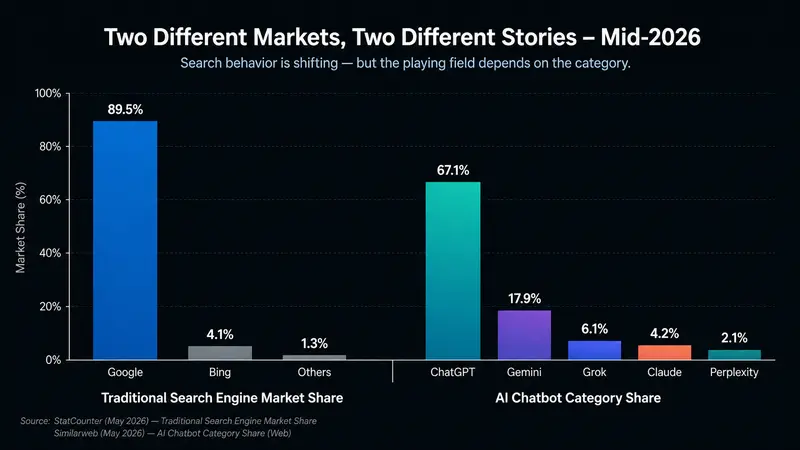
By the narrowest, most literal definition — which search engine's address bar or app you typed a query into — Google is barely dented. StatCounter's July 2026 data puts Google at roughly 89.5% of global search engine traffic, down only slightly from around 91% in 2023. Bing sits a distant second at about 4%. ChatGPT Search, the dedicated search product inside the ChatGPT app, still shows up as a rounding error in this dataset, well under half a percent of raw search-engine queries.
If you liked this sectionZero-Click Search Is Here. Now What?Widen the lens to "where do people go to have a question answered," and the picture changes substantially. Several independent analyses tracking combined search-plus-AI-chatbot usage estimate that Google's share of total information discovery — every query typed into a browser, a chatbot, or an AI assistant — has fallen from roughly 89% in late 2022 to somewhere between 57% and 80%, depending on the methodology and whether AI Overviews inside Google Search are counted as "Google" or as a separate AI layer. ChatGPT, across all its interfaces, is now estimated to account for somewhere around 17–20% of that combined query volume.
So both statements — "Google controls 89% of search" and "Google's share of discovery has collapsed by 30 points" — are technically defensible, because they are answering different questions. That distinction matters enormously for anyone deciding how to allocate a content or marketing budget in the second half of 2026, which is exactly why we built out the SEO-versus-GEO comparison in more detail in an earlier piece.
SEO vs GEO: What's the Difference?
If the market-share confusion above left you wondering which discipline actually protects your traffic going forward, this is the deeper breakdown.
Read SEO vs GEOWhat Google's Own Earnings Say
If ChatGPT were genuinely killing Google's core business, it would show up first in the one place a public company cannot spin: the quarterly earnings release.
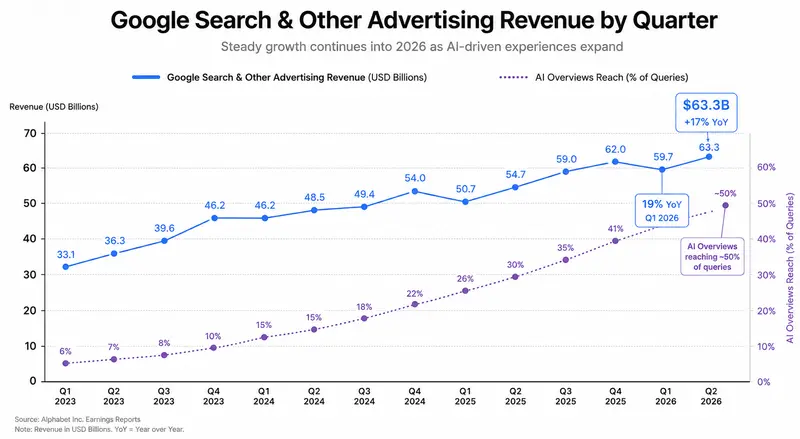
It has not shown up there yet. Alphabet's Q2 2026 results, published July 22, reported Google Search & other revenue of $63.3 billion, up 17% year over year — an acceleration compared to prior quarters, not a slowdown. Total Alphabet revenue grew 24% to $119.8 billion. On the earnings call, CEO Sundar Pichai told investors that search queries were at an all-time high and credited AI Overviews and the newer AI Mode experience with driving that growth, noting that AI Mode alone had surpassed one billion monthly active users inside Google's own products.
That framing deserves a healthy dose of skepticism — it is Google's own interpretation of Google's own numbers, and the company has every incentive to describe AI as a tailwind rather than a threat. But the underlying figures are independently verifiable through Alphabet's SEC filings, and they are consistent across the last several quarters: 19% Search revenue growth in Q1 2026, 17% in Q2 2026, with queries described as growing rather than shrinking in every quarter of the year so far.
The honest caveat, made by several analysts covering the results, is that revenue holding up is not proof that the underlying click economy is healthy. Google can keep growing ad revenue on fewer, more expensive clicks for a long time before real strain shows up in the topline numbers. That distinction — Google-the-company doing fine, while the open web that depends on Google clicks does not — is the real story hiding underneath the earnings headlines.
The Real Casualty: Publisher Clicks, Not Google's Revenue
The most consistent finding across every independent study published in 2026 is not that Google is losing. It's that the pages Google used to send traffic to are losing, even while Google itself keeps growing.
Zero-click search — a query answered directly on the results page, with no click to any external website — has been rising for years, but AI Overviews accelerated the trend sharply. Research based on large clickstream panels put the global zero-click rate at roughly 58–60% of all searches, climbing to around 77% on mobile. When an AI Overview specifically appears above the results, the traditional organic click rate falls even further: multiple studies converge on somewhere between a 58% and 65% reduction in click-through rate compared to a results page without one, and one publisher's submission to UK regulators described drops as steep as 89% for some of its content.
- Organic click-through rate on AI-Overview queries fell from roughly 1.76% (mid-2024 baseline) to around 0.61% by late 2025 — a 65% decline, according to Seer Interactive's longitudinal tracking
- HubSpot's own leadership publicly acknowledged organic traffic falling from around 13.5 million monthly visits to under 7 million after AI Overviews scaled — a 70–80% drop from its peak
- The median publisher tracked in a 2025–2026 industry analysis saw organic traffic decline roughly 10% year over year, with non-news content sites losing more (around 14%) than hard-news publishers (around 7%)
- Digital Content Next found an additional 10% search-traffic decline among member publishers in a single two-month window
- Brands that are directly cited inside an AI Overview see the opposite effect — one analysis found cited brands earning roughly 35% more organic clicks and 91% more paid clicks than uncited competitors on the same query
That last point is the one most "Google is dying" headlines skip entirely. The click economy isn't vanishing uniformly — it's redistributing toward whichever handful of sources the AI layer decides to cite, and away from everyone else. For a large publisher with dozens of writers and a diversified traffic base, a 10% dip is painful but survivable. For a small business blog or a niche affiliate site built entirely around ranking for informational queries, the same dynamic can be existential. We covered exactly this shift, and what to do about it, in our earlier look at zero-click search.
Zero-Click Search Is Here. Now What?
A practical breakdown of how zero-click behavior changes content strategy, and which formats still earn clicks in an AI-summarized search results page.
Read the Zero-Click PlaybookSearch Engine Journal: AI Overviews' Impact on Publishers
One of the most detailed independent write-ups of how AI Overviews changed click-through behavior across major publisher categories.
Read the Full ReportWhere ChatGPT Is Actually Winning — and Where It Isn't
Strip away the Google comparison for a moment and look at ChatGPT purely against its AI-chatbot rivals. That is a market it dominates, and one where its lead is shrinking fast.
ChatGPT crossed one billion monthly active users in May 2026, the fastest any consumer app has hit that milestone. Average session length reportedly runs longer than most competing chatbots, which analysts read as a sign of genuinely deep engagement rather than casual, one-off use. But within the AI-chatbot category specifically — ChatGPT versus Gemini, Claude, Grok, and Perplexity — ChatGPT's own share of that traffic has been sliding. Multiple traffic-analytics firms tracking the category independently found ChatGPT's share of AI-chatbot web traffic falling from roughly the high-80s percentage range in early 2025 to somewhere in the mid-to-high 60s by early-to-mid 2026, with Google's own Gemini the biggest beneficiary of that shift, and Grok posting rapid gains after its deeper integration into X.
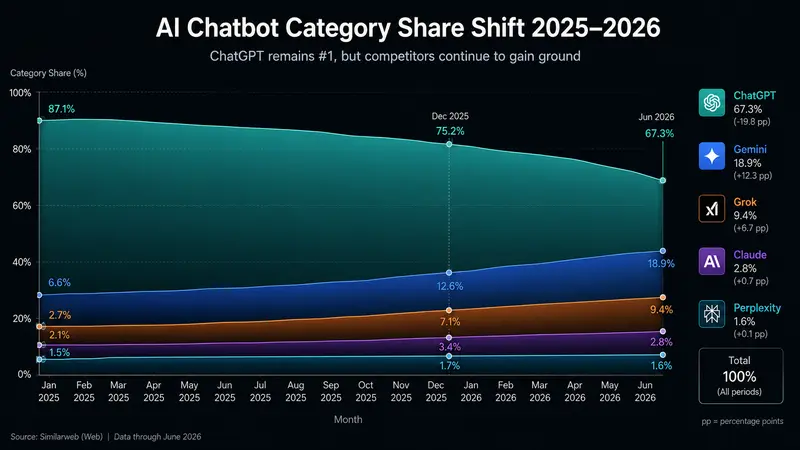
Meanwhile, ChatGPT's direct referral traffic to third-party websites — the number that matters most to publishers — remains small in absolute terms even as it grows quickly in relative terms. Referral-tracking firms monitoring hundreds of brand websites recorded ChatGPT's slice of AI-driven referral sessions rising noticeably year over year, even as ChatGPT's internal share of the AI-chatbot category itself was falling; one analysis measured a jump from under 0.2% to nearly 0.3% of total site referrals, which sounds tiny until you remember Google alone still sends the overwhelming majority of external referral traffic on the open web. The pattern is consistent: ChatGPT is becoming a meaningfully larger discovery surface, but it has not come close to matching Google as a traffic-sending mechanism, because that was never really the product's design goal in the first place.
This is the piece that gets lost in most "ChatGPT vs Google" framing. ChatGPT was built to answer questions inside its own interface, the same way AI Overviews were built to answer questions inside Google's results page. Neither product was designed to maximize outbound clicks. Both are, structurally, zero-click-first experiences — they just arrived at that destination from different starting points, which is the argument we made when we first wrote about AI agents reshaping how websites need to be built.
The Death of Traditional Websites: Designing for AI Agents
If AI answers, not links, are becoming the default discovery layer, your site's structure needs to change. Here's what that means in practice.
Read the Full GuideSo, Is ChatGPT Killing Google? The Honest Answer
No — not in the sense the headline implies. But yes, in a much narrower and more important sense than most coverage admits.
Google-the-company is not dying. Search revenue is growing at double-digit rates, query volume is at an all-time high by Google's own account, and the company is spending well over $150 billion a year on infrastructure specifically because demand for its AI products is outstripping supply. If ChatGPT were meaningfully siphoning off Google's core revenue engine, that spending pattern and those growth numbers would not exist in their current form.
What is dying, or at least shrinking hard, is the specific economic relationship that funded the last two decades of the open web: rank well on Google, receive a click, monetize that click with ads or subscriptions or product sales. That mechanism is being replaced, query by query, by a summarize-and-cite mechanism where AI systems — Google's own AI Overviews chief among them, not just ChatGPT — answer the question directly and send a click only to a small, often shrinking, set of cited sources. ChatGPT accelerated public awareness of that shift by being the first mainstream product to make "just ask the AI instead of searching" feel normal. But Google built and shipped the version of that same behavior that is doing the most damage to publisher click-through rates right now, inside its own results page, largely in response to the competitive pressure ChatGPT created.
In other words: ChatGPT didn't kill Google. It pushed Google to compete with itself in a way that is quietly killing the open web's click economy — and Google's revenue is currently strong enough to absorb that trade-off without it showing up on a balance sheet.
What This Means for Your Content Strategy Right Now
None of this is an argument for abandoning search-driven content. It's an argument for updating what "winning" a search query actually means in 2026.
- Stop measuring success only in clicks. Citation frequency inside AI Overviews, ChatGPT, and Perplexity is becoming a leading indicator of brand visibility even when it doesn't show up in Google Search Console
- Prioritize the content types that still earn clicks: comparisons, tools, calculators, original data, and anything requiring a decision rather than a definition
- Structure pages so both traditional crawlers and AI answer engines can extract a clean, citable summary near the top of the page, not buried under 800 words of preamble
- Track referral traffic from ChatGPT, Perplexity, and Gemini separately in your analytics — most standard SEO dashboards still don't surface this by default
- Treat branded search volume as a health metric. Being asked about by name inside a chatbot is one of the few discovery channels AI Overviews cannot fully absorb
This is precisely the shift we mapped out when we argued that content strategy built purely around click volume was already becoming obsolete, and it's the same reasoning behind building topical authority deliberately, in clusters, rather than chasing individual keywords one article at a time.
Content Clusters for GEO: Build Topical Authority AI Engines Trust
The practical framework for structuring content so AI search engines cite you, not just rank you.
Read the GEO FrameworkAlphabet Q2 2026 Earnings — Sundar Pichai's Remarks
The primary source for Google's own account of Search revenue growth and AI Mode adoption, straight from the earnings call transcript.
Read the Official RecapConclusion: Wrong Question, Useful Data
"Is ChatGPT killing Google" is the wrong question to be asking in 2026, but chasing the answer surfaces exactly the data anyone running a content, marketing, or SEO strategy actually needs.
Google's core business is not under near-term threat — the earnings prove that. The open web's dependence on Google-sent clicks is under very real, already-measurable threat — the click-through-rate studies prove that too. ChatGPT is a meaningful and fast-growing part of that second story, but it's competing inside a shift that Google itself is driving through AI Overviews and AI Mode, largely because it has no better option than to compete with the very thing threatening its click economy before someone else does it first.
The practical takeaway isn't to panic about ChatGPT specifically. It's to stop assuming that a page one Google ranking guarantees a visitor, because for a growing share of queries, it no longer does — regardless of which company's logo is doing the summarizing.
(Frequently asked questions)
Is ChatGPT actually taking search market share away from Google?
In the narrowest sense — which search engine people type queries into — barely. Google still holds roughly 89.5% of global search engine traffic as of mid-2026. ChatGPT's dedicated search product remains under 1% of that specific metric. The bigger shift shows up in a broader measure of 'information discovery' that includes chatbot usage, where Google's combined share has fallen substantially over the past three years.
If ChatGPT isn't hurting Google's search share, why does Google keep changing its results page?
Because the threat Google is responding to isn't really ChatGPT market share — it's ChatGPT changing user expectations. Once people got used to getting a direct answer instead of a list of links, Google had to ship AI Overviews and AI Mode to avoid losing that behavior to a competitor, even though doing so also reduces clicks to the websites Google's own results used to send traffic to.
Why is Google's revenue growing if AI Overviews reduce clicks?
Because revenue and clicks aren't the same thing. Google can serve fewer, more targeted ad impressions per search and still grow revenue if advertisers pay more for the remaining clicks, or if overall query volume rises. Alphabet's Q2 2026 results showed 17% Search revenue growth alongside record query volume, even as independent studies show organic click-through rates falling sharply on AI-Overview queries.
Which websites are losing the most traffic from AI search?
Sites built around simple, factual, informational queries — 'what is,' 'how to,' basic definitions — are losing the most, since AI systems answer those directly. Comparison content, tools, calculators, and pages requiring a decision rather than a fact tend to hold up better, because they're harder for an AI summary to fully replace.
Should I stop investing in SEO because of AI search?
No, but the goal needs to expand beyond ranking. Being cited inside AI Overviews, ChatGPT, and Perplexity answers is becoming its own visibility channel, separate from traditional organic rankings, and it rewards clear structure, original data, and topical authority more than keyword density.
Is Bing or another search engine gaining from this instead of ChatGPT?
Slightly. Bing has grown to roughly 4% of global search engine share, partly through its OpenAI-powered Copilot integration, but it remains far behind Google. No single competitor has captured a large enough share to represent an immediate threat to Google's core search dominance.