Zero-Click Search Is Here. Now What?

For every 1,000 Google searches in 2026, only 360 end with a click to the open web. The other 640 are resolved on the results page itself. If your traffic strategy is still built around ranking positions, you are measuring the wrong thing — and losing ground to brands that already know it.
The Number That Changes Everything
For every 1,000 Google searches in 2026, only 360 result in a click to any external website. The other 640 end on Google's own results page — answered by an AI Overview, a featured snippet, a knowledge panel, or a direct answer box. The user got what they needed. They just never visited you to get it.
This is not a forecast. It is the current measured reality of search, documented by SparkToro's clickstream panel of millions of users, corroborated by Bain & Company's primary consumer research, and accelerating quarterly. The share of searches producing at least one click to the open web fell 9.51 percentage points between 2024 and 2026 — a 22.9% decline in under two years. Google AI Overviews, which now trigger on approximately 48% of all tracked queries, push the zero-click rate to 83% on the queries they touch. In Google's newer AI Mode, the rate reaches 93%.
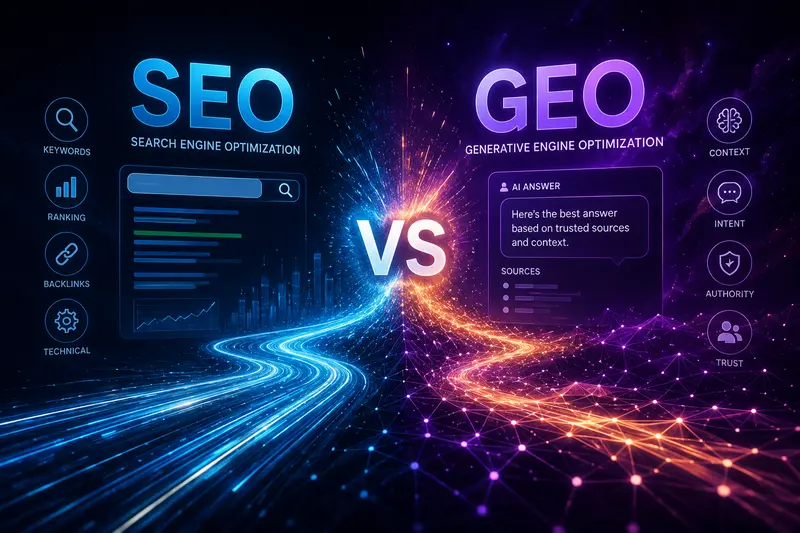
If you liked this sectionSEO vs GEO: What's the Difference?The industries absorbing the worst of it are informational content, health, technology, and publishing — exactly the verticals where 'rank for keywords, drive traffic' was the entire growth strategy. Some sectors have reported 40 to 70% organic traffic declines in a single year. The question is no longer whether this is happening. The question is what to do about it.
The Anatomy of an AI Overview: How Google Selects What to Cite
Understanding what actually happens inside an AI Overview is the first step toward earning a place in one. Google's generative search systems do not simply summarize the top three search results. They synthesize across multiple sources, weigh authority signals, and prioritize information density over keyword density.
When a user submits a query, Google's retrieval system pulls candidate passages from its index — much like a traditional search — but then passes those passages through a large language model that composes a coherent answer. The model does not see your full page; it sees extracted text chunks that fit within its context window. If your most valuable facts are buried deep in a long paragraph, they may never reach the model at all. If they are clearly stated in a bullet list, a short declarative sentence, or an FAQ block, they are far more likely to be included.
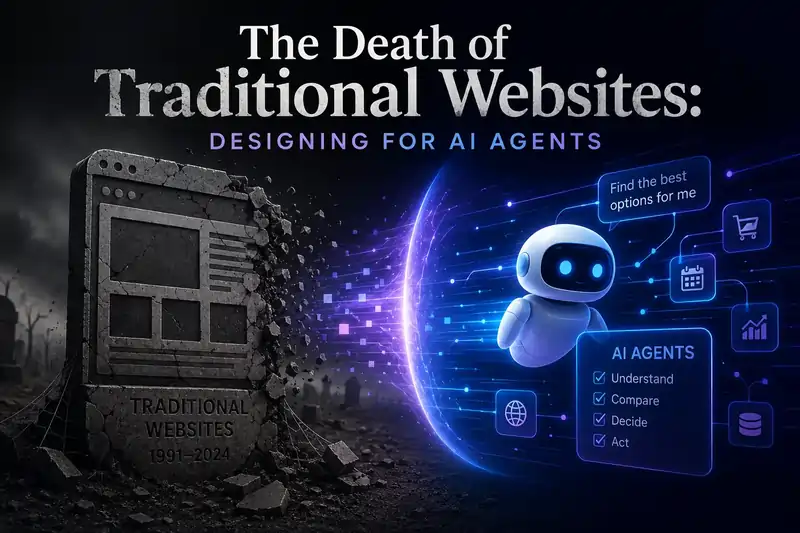
If you liked this sectionThe Death of Traditional Websites: Designing for AI AgentsThis is why content structure now matters as much as content substance. The AI Overview citation process is not a black box — it is a retrieval-augmented generation pipeline with predictable inputs. The inputs that win are: concise answer-first sentences, clear heading hierarchies, factual claims supported by named sources, and schema markup that explicitly labels Q&A content. Pages that deliver these inputs reliably earn citations even when they rank lower than pages with more inbound links.
Google's AI Overview does not read your page like a human. It extracts snippets from your HTML, strips formatting, and selects passages based on fact density and source authority. If your key answer is not in the first 200 words of a section, it may never be considered for citation.
What Actually Happens When Someone Searches Now
To understand why zero-click search demands a strategy change rather than a tactical adjustment, it helps to trace what actually happens in a modern search session — not as it was in 2020, but as it is today.
A user types a question into Google. Before any organic results appear, an AI Overview synthesizes an answer from multiple sources, presents it at the top of the page, and attributes a handful of citations at the bottom. Seven in ten users read only the first few lines of the AI Overview. If the answer satisfies them, they stop. The session ends. The organic result that would have received the click — possibly a page you spent months optimizing — was never seen.
On some queries, the cited source in the AI Overview sees an 18% increase in CTR for branded searches — because the AI endorsement acts as a trust signal. But on pure informational queries, Seer Interactive's analysis of 25.1 million organic impressions across 42 organizations found that CTR dropped from 1.76% to 0.61% when an AI Overview appeared — a 61% relative decline. Being cited is now more valuable than ranking first.
Why This Happened: A Brief History of Search Losing Its Clicks
Zero-click search is not a new phenomenon created by AI Overviews. It is a trend that has been building since Google introduced the Knowledge Graph in 2012 and Featured Snippets in 2014. AI Overviews did not start the fire — they poured fuel on one that had been burning for a decade.
Rand Fishkin of SparkToro first rigorously quantified zero-click search in 2019 at roughly 50%. By 2021, clickstream data from Datos placed it at 64.82%. Every major SERP feature Google introduced — People Also Ask boxes, calculator modules, currency converters, knowledge panels, local packs — was designed to resolve user intent inside Google's own interface rather than route the user outward. The ad-supported business model incentivizes keeping users on the page. Organic click-through was always a side effect, not a goal.
Google AI Overviews, which scaled broadly from mid-2024, compressed years of gradual change into months. They now appear on approximately 48% of all queries — up 58% year-over-year according to BrightEdge — and trigger on 82% of B2B technology queries specifically. Gartner forecast in February 2024 that traditional search volume would drop 25% by 2026. The data suggests the forecast was, if anything, conservative for information-heavy verticals.
AI Overviews now resolve virtually every informational 'how to', 'what is', and 'why does' query without sending users to external sites. If the majority of your organic traffic comes from definitional, educational, or guide-format content, you are in the category most exposed to zero-click disruption. The Seer Interactive 61% CTR decline applies specifically to this segment — not uniformly to all traffic. Commercial-intent and transactional queries still see much lower AI Overview rates and much higher click-through.
The Clicks That Still Happen — and Why They Matter More
Here is the counter-intuitive finding buried in the data: the users who do click through in a zero-click world are better visitors than the ones who used to click. Semrush found that AI-referred visitors convert at 4.4 times the rate of traditional organic search visitors. The clicks that survive are from users who read an AI summary, decided it wasn't enough, and actively chose to go deeper.
This changes the nature of the traffic your site should aim for. Pre-AI search sent you a wide funnel: many users with varying intent, most of them browsing, a small fraction ready to act. Post-AI search sends a narrower but more qualified funnel: fewer users, but a much higher concentration of ones in a decision or evaluation phase. For businesses with strong conversion economics, the total value of search traffic may not have fallen as sharply as the volume suggests.
The implication is strategic: optimizing solely to recover lost traffic volume is the wrong goal. Optimizing to win citations in AI Overviews — so that the users who do click arrive pre-sold on your credibility — and then converting those high-intent visitors is the right goal. Volume and quality have decoupled. Strategy needs to follow.
Brands cited inside a Google AI Overview earn 35% more organic clicks and 91% more paid clicks than non-cited brands on the same SERP. Appearing in the AI answer does not replace traffic — it upgrades the traffic you receive. (Seer Interactive, 2026)
Search has not ended. The referral has ended. Your brand can dominate a topic in AI-generated answers and receive zero clicks from it. That is not failure — it is a new form of visibility that your current analytics stack cannot see.